
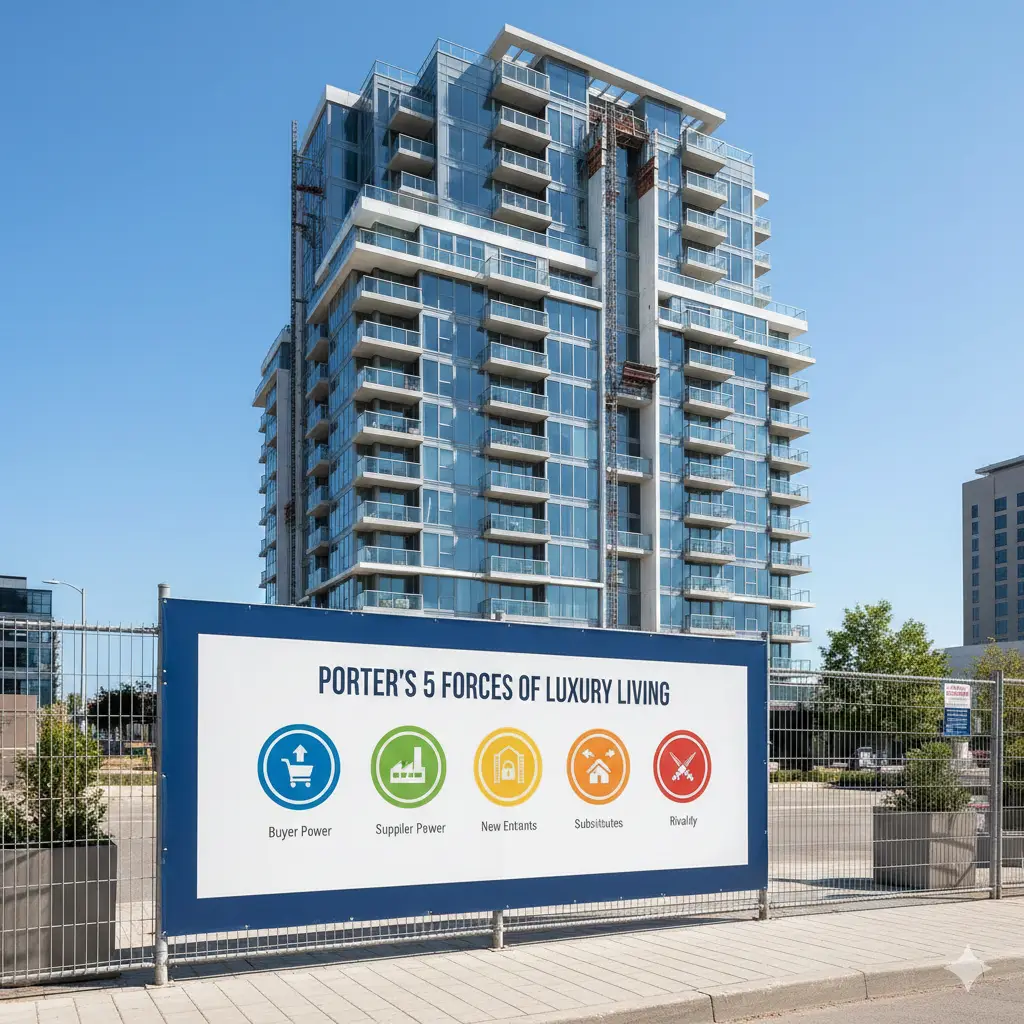
As a civil engineer with a Masters in Management,I’ve noticed something:most people don’t mess up when buying a flat because they’re careless they mess up because they don’t have a proper framework to make the decision.Real estate is tricky.There’s pricing pressure,big promises,and a lot of hidden trade-offs.That’s why I like using Porter’s 5 Forces,it’s a management tool that actually helps you understand what you’re getting into before you put down your life savings.
Porter’s 5 Forces for Buying a Flat
Here’s how I think about it:you’re the customer,the builder’s the seller,and the area is your market.Your goal?Buy a flat with less risk,better value,and decent resale potential.
Competitive Rivalry(How many similar projects are out there?)
This one’s pretty straightforward.If there are 8–10 projects nearby selling similar 2BHK or 3BHK flats,the builder isn’t that special.You’ve got options.High competition means better deals and more room to negotiate.Low competition means the builder sets the price.Quick check:visit sites within a 3–5 km radius and compare price per sq ft,carpet area,actual possession timeline,maintenance costs,and how well the floor plan uses space.
Buyer Power(How much leverage do you actually have?)
Buyer power is basically:can you walk away without feeling bad about it?You’ve got power when lots of units are still unsold,the builder’s running “limited time offers”,you already have loan approval and down payment ready,and you’re not emotionally locked into one specific flat. You don’t have much power when the project’s almost sold out,the location is genuinely unique(metro-facing,corner unit,etc.),or the builder’s pushing urgency with lines like “only 2 units left”.Real talk:if you look desperate,you’ve already lost.
Supplier Power(What could delay your project or hurt quality?)
In real estate,suppliers aren’t just cement and steel.Supplier power includes contractors and labour availability,approval authorities,landowner JV partners,and the builder’s cash flow situation.This tells you:will you get possession on time?Will they maintain quality or cut corners?If the builder’s struggling financially,they might delay possession indefinitely,switch to cheaper materials,lower finishing quality,or keep making excuses.That’s why I personally prefer projects that are 90% done,where finishing work is actually happening.I don’t want to buy a promise.
Threat of Substitutes(What else could you do instead?)
Buying this flat isn’t your only choice. You could buy a resale flat that’s ready to move into,rent instead of buying,look at nearby areas with better value,or consider a plot or row house if that’s an option.If substitutes are strong,don’t overpay.Simple rule:if rent is way cheaper than your EMI + maintenance,the builder’s probably overcharging.
Threat of New Entrants(New projects that could hurt your resale)
This one doesn’t get talked about enough.Even if your flat seems great today,if 5 new towers pop up nearby in the next couple of years,your resale value takes a hit,appreciation slows down,and rental competition goes up.Check for empty land around the area,upcoming township projects,what brokers are saying about the pipeline,and new RERA registrations nearby.Too much supply means trouble selling later.
What This Framework Actually Does
Once you run through Porter’s 5 Forces,you’ll have a clearer picture of whether you should push hard on price,whether the pricing is realistic or just hype,whether you’re taking a risk with possession timelines,whether you’ll be able to resell or rent easily,and whether the area is getting oversupplied.
Most people pick a flat based on vibes,the view,and carpet area.Nothing wrong with that.But using a framework like this helps you look at it like an investor would.Use your emotions to choose your home…but use logic to protect your money.Hope this helps someone avoid a costly mistake.