
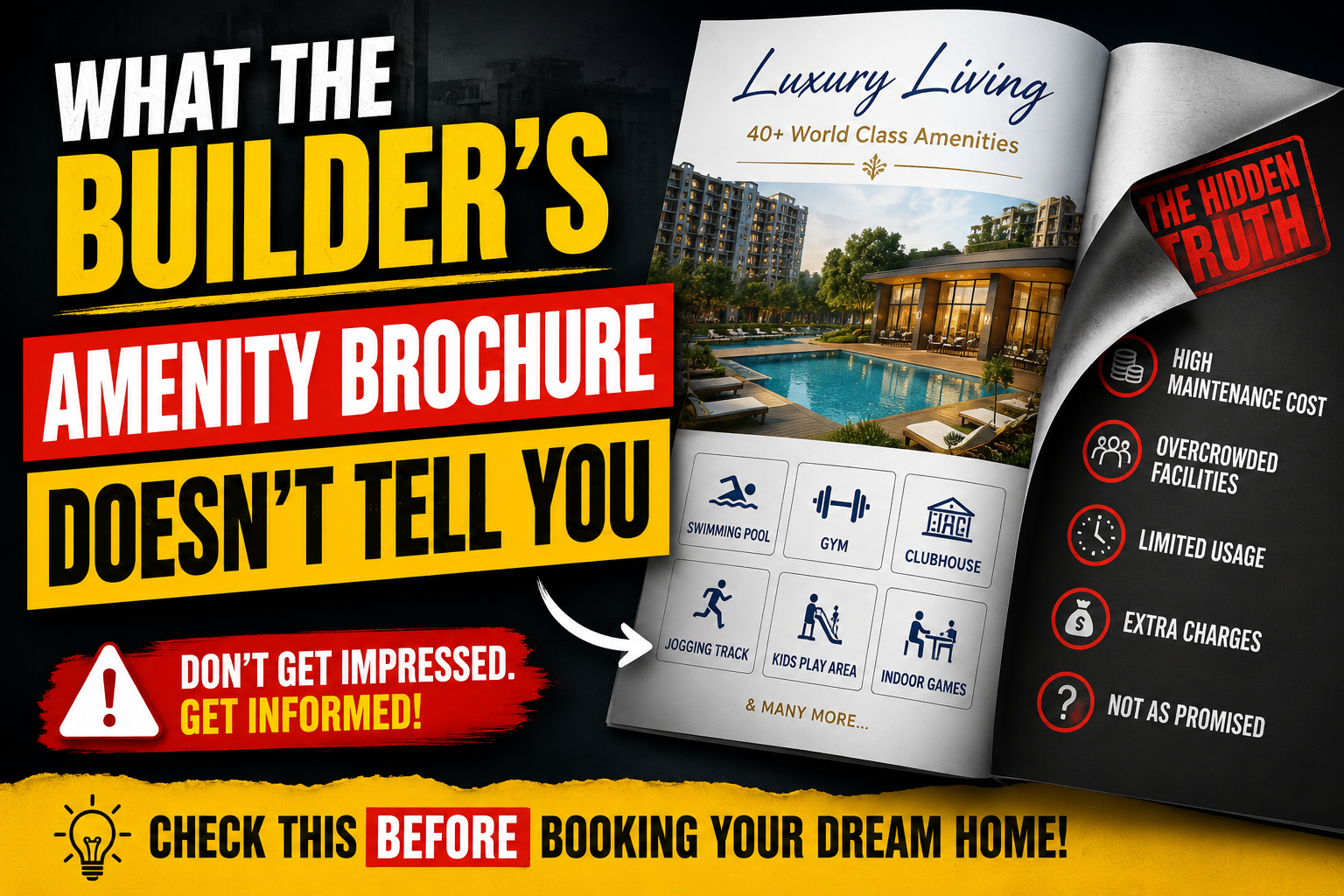
When you visit a new apartment project, the sales brochure can make you feel like you are buying a five-star resort. Swimming pool. Gym. Clubhouse. Jogging track. Indoor games. Squash court. Party hall. Co-working space. Kids’ play area. Senior citizen zone. Landscaped gardens. Yoga deck. Pet park. The list goes on. And then the salesperson says: “Sir, this project has 40+ amenities.”
Sounds impressive. But here’s the question I think every homebuyer should ask: How many of these amenities will actually improve MY life? Because buying an apartment isn’t the same as buying a resort membership. You are buying a home that you may live in for 5, 10, 20 or even 30 years. So instead of asking: “How many amenities does this project have?” Ask: “Which amenities match the way my family actually lives?”
1. Start With Your Lifestyle – Not the Brochure
Imagine two buyers.
Buyer A
- Goes to the gym 5 days a week
- Runs every morning
- Doesn’t swim
- Rarely attends parties
- Works from the office
- Has no children
For this person, the priorities might be:
Gym → Walking/Jogging Track → Open Space → Security → Parking. The swimming pool may be almost irrelevant.
Buyer B
- Has two children
- Works from home
- Doesn’t go to the gym
- Uses outdoor spaces frequently
- Has elderly parents
Their priorities could be: Children’s Play Area → Open Space → Walking Area → Senior-Friendly Facilities → Co-working/Quiet Space → Accessibility.
Same apartment project. Completely different amenity value. That’s why I think amenity evaluation should start with lifestyle profiling.
2. Convert Your Lifestyle Into Activities
Don’t immediately look at amenities. First write down what you actually do during a normal week. For example:
My lifestyle → I exercise 5 days/week → Weight training + walking → Therefore I need: Good gym + usable walking track.
Another example:
Family with children → Children play every evening → Need: Safe, accessible, appropriately sized play area. Another:
Work from home → Need quiet space for meetings → Need: Quiet work area / business lounge / suitable home-office environment. This simple exercise changes the way you look at projects.
3. Use the Frequency × Importance Test
Here’s a simple method I would recommend. For every amenity, give two scores.
Frequency
How often will you use it?
- 0 — Never
- 1 — Occasionally
- 2 — Monthly
- 3 — Weekly
- 4 — Several times a week
- 5 — Almost daily
Importance
How important is it to your lifestyle?
- 0 — Doesn’t matter
- 1 — Low importance
- 2 — Somewhat useful
- 3 — Important
- 4 — Very important
- 5 — Essential
Then: Amenity Value = Frequency × Importance. For example:
| Amenity | Frequency | Importance | Value |
|---|---|---|---|
| Gym | 5 | 5 | 25 |
| Walking track | 4 | 4 | 16 |
| Kids play area | 3 | 4 | 12 |
| Swimming pool | 1 | 2 | 2 |
| Party hall | 1 | 1 | 1 |
Now you have something much more useful than a brochure. You have a personal amenity priority list.
4. Don’t Confuse “Exists” With “Usable”
This is probably the biggest mistake. A brochure says: “World-class gym.” Okay. But what does that actually mean?
Ask:
- How large is the gym?
- What equipment is provided?
- Are there free weights?
- How many residents will use it?
- What are the operating hours?
- Is ventilation adequate?
- Is air conditioning available?
- Is there a maintenance contract?
- Are there additional charges?
- Can the society change the facility later? The same applies to a swimming pool. A project might technically have a swimming pool. But a small pool shared by 1,500 apartments is very different from a properly sized facility serving 300 apartments. Amenity presence ≠ amenity usability.
5. Look at Amenity-to-Population Ratio:
This is something I wish more homebuyers asked. Suppose:
Project A: 300 apartments, 1 gym. Project B: 1,500 apartments, 1 gym. Both projects can advertise: “Fully equipped gymnasium.” But the user experience could be completely different.
Do the same analysis for: Swimming pool, Gym, Sports courts, Clubhouse, Children’s play area, Parking, Lifts, and Visitor parking. Ask the developer: “How many apartments will ultimately share this facility?” Especially in large township projects where multiple phases may eventually share common facilities.
6. Divide Amenities Into Three Buckets
I would personally classify them into three categories.
A. Must-Have
These directly support your lifestyle. For example: Gym, Walking track, Children’s play area, Good parking, Security, and Accessible common areas.
B. Nice-to-Have
Useful, but not essential. For example: Swimming pool, Clubhouse, Sports court, Indoor games, and Party hall.
C. Marketing Amenities
They sound impressive but may have little practical value for you. For example: Decorative features, Extremely specialized recreational facilities, Multiple themed lounges, and Facilities you know you will rarely use. The important point isn’t that these amenities are “bad.” The point is: Don’t pay a premium for something simply because it sounds luxurious.
7. Ask: “What Am I Paying to Maintain?”
This is where the discussion becomes more interesting. Amenities aren’t free after possession. Someone has to pay for: Electricity, Cleaning, Security, Staff, Landscaping, Pool maintenance, Equipment repairs, Air conditioning, Replacement of damaged equipment, and Periodic refurbishment. And those costs can eventually show up in your maintenance bill.
There are already discussions among Indian apartment residents about rising maintenance costs in amenity-heavy communities. One recent Reddit discussion, for example, described projects with maintenance charges reaching ₹12–25 per sq ft in some markets, although such figures vary significantly by project and city.
So don’t ask only: “What amenities am I getting?” Also ask: “What will it cost me to keep them running?”
8. Don’t Fall for “Free Amenities”
When somebody tells you: “Sir, all these amenities are free.” I would mentally translate that into: “There may be no separate ticket price right now.”
The facilities still require money to construct, operate and maintain. In some projects, clubhouse or amenity charges can also be structured separately from regular common-area maintenance or involve user charges. The exact structure depends on the project documents and applicable rules.
So before booking, ask for the complete cost structure in writing.
9. Check What Is Actually Promised
This is extremely important. Don’t rely only on: Salesperson’s verbal promise, WhatsApp messages, Brochure, Marketing video, or Show-flat experience. Check the approved project documents and your agreement. This matters because disputes over promised amenities do happen. In July 2026, for example, Karnataka RERA directed a developer to provide promised amenities and transfer certain project assets/facilities to the residents’ association.
In Maharashtra, MahaRERA has also issued directions concerning detailed disclosure of amenities in sale agreements. And in a recent Maharashtra case, MahaRERA directed a developer to refund ₹5 lakh collected towards a clubhouse that remained unbuilt years after possession.
The lesson isn’t: “Never trust builders.” The lesson is: If an amenity matters to your buying decision, don’t leave it as a verbal promise. Verify how it is documented.
10. Ask About the Future, Not Just Today
Your lifestyle can change. Today: Young couple → Gym, Swimming pool, Social spaces. Five years later: Young family → Children’s play area, Open spaces, School access. Ten years later: Older parents → Walking paths, Seating, Accessibility, Healthcare access. So before booking, ask yourself: “Will this project still work for my family 10 years from now?” This is especially important if you’re buying your supposed “forever home.”
11. Visit the Project at Different Times
Don’t evaluate amenities only during the sales office’s preferred visiting hours. If possible, observe the project:
- Morning: How many people use the gym and walking track?
- Evening: Is the children’s area crowded?
- Weekend: Does the clubhouse become overcrowded?
- Peak hours: How long do people wait for lifts? You are trying to see the difference between brochure capacity and real-life capacity.
12. Talk to Existing Residents
This can be more valuable than another sales presentation. Ask residents:
- “Which amenities do you actually use?”
- “Which ones are usually empty?”
- “How much is the monthly maintenance?”
- “Are there separate charges for any facilities?”
- “How often does equipment break?”
- “Does the pool remain operational throughout the year?”
- “Is the gym overcrowded during peak hours?”
- “Has the society had to spend heavily on repairs?”
Residents are experiencing the post-sale reality that the brochure cannot show you.
13. Think About Resale Too
Here’s an interesting question: If you don’t use an amenity, does it have zero value? Not necessarily. Amenities can contribute to the overall attractiveness of a project. But don’t automatically assume: More amenities = higher resale value. Your future buyer may have completely different priorities. A buyer might care more about: Location, Carpet area, Floor plan, Parking, Natural light, Ventilation, Maintenance cost, School access, Transport, and Construction quality than whether the project has a mini theatre. So I would treat amenities as one component of property value, not the entire value proposition.
Maybe Project X has 50. But if you regularly use only 5, while Project Y has 10 that perfectly match your lifestyle, Project Y could be the better home for you. So next time a salesperson says: “Sir, our project has 40+ lifestyle amenities.” Don’t immediately get impressed. Ask: “Which five of these will actually improve my life—and what will I pay to maintain them for the next 10 years?”
That is the question I would want every homebuyer to ask before paying the booking amount.