
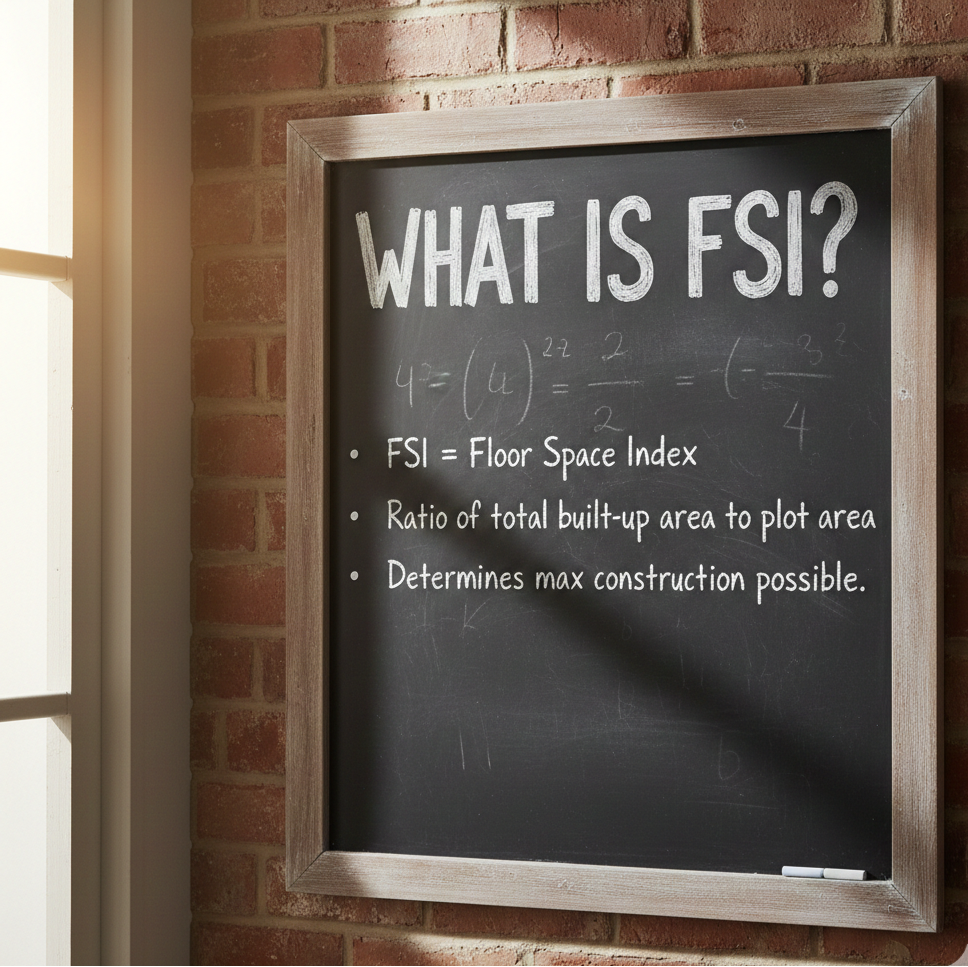
If you are planning to buy a flat, there is one term you will keep seeing in documents, brochures, and RERA papers: FSI. Most buyers ignore it, but once you understand it, you start seeing projects very differently.
What FSI Means?
FSI means Floor Space Index.
The formula is: FSI = Total construction area allowed (total built-up area) / Plot area
In simple words, it tells you how much building can be constructed on a given piece of land. It is basically the rule that controls the size of the building on that plot. Simple Example
Suppose the plot area is 1000 sq.m and the FSI allowed by the government is 2. That means the builder can construct:
1000 × 2 = 2000 sq.m total floor area
This construction can be arranged in different ways, such as:
- 2 floors of 1000 sq.m each, or
- 4 floors of 500 sq.m each
(depending on height rules, setbacks, and planning norms).
Why FSI Matters to Buyers?
FSI directly affects how many flats can be built on the same land. Let’s take the same example again. If the FSI becomes 3:
1000 × 3 = 3000 sq.m
Earlier the builder could construct 2000 sq.m, but now an extra 1000 sq.m is allowed. This means more flats can be built, builder revenue increases, and land cost per flat reduces. That’s why many builders prefer areas where higher FSI is allowed.
How FSI Is Decided (And Who Decides It)
FSI is controlled by the government and planning authorities. It is not random it is based on how much load an area can handle. Some key factors are:
- Road width
Small roads cannot handle heavy traffic. Wider roads support more vehicles and people, so they usually get higher FSI.
2. Infrastructure capacity
If the area has strong water supply, drainage, electricity, and civic systems, higher FSI may be permitted. If infrastructure is weak, FSI is kept lower.
3. Public transportation
Areas with good public transport can handle higher population density, so FSI is often higher there.
4. Environmental and safety restrictions
FSI is reduced in flood-prone areas, coastal zones, hilly regions, and airport zones. This is done for safety and environmental protection.
What We’ll Do Next
In the next topic, we will use this same FSI concept to understand how you can check the density of a project from documents alone, even before visiting the site. Once you know this, brochures won’t confuse you anymore. I hope this helped you understand FSI clearly.