

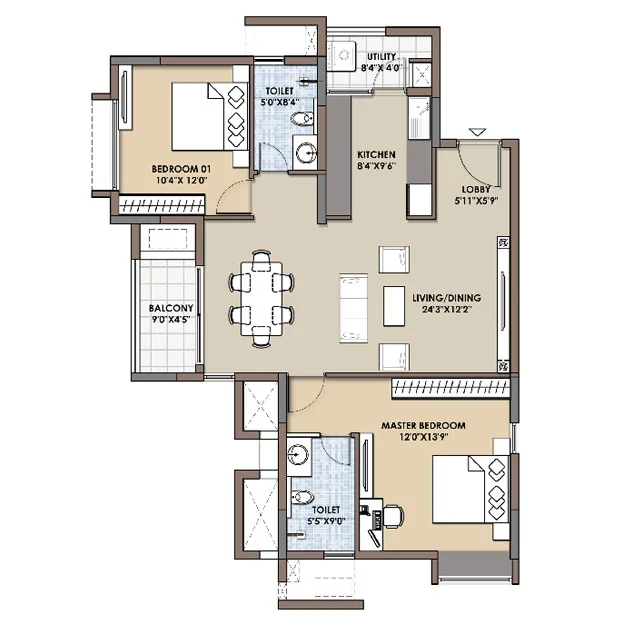
When you buy a flat, you check layout, carpet area, sunlight, fittings, and modular kitchen space. But the most underrated daily-life issue is a kitchen that cannot throw out heat + smell properly. And this problem does not show up on brochures. It shows up after you move in, when your house smells like tadka + frying even after 1 hour. As a civil engineer + management grad, I treat this like a system:
Engineering view: air volume vs exhaust capacity. Management view: bottleneck + real-world losses (duct bends, backpressure, weak fresh air entry).
The one question buyers should ask
Before booking a flat, ask yourself: “Can this kitchen actually replace its air fast enough during 1 hour of Indian cooking?”
If not, you will feel:
– warm kitchen
– smell spreading into living room
– oily walls
– fungus risk in corners/cabinets
Most buyers rely on:
– “there is an exhaust fan”
– “there is a duct”
– “chimney can be installed later”
But here is the real issue: Rated airflow ≠ real airflow. Apartment ducts reduce airflow due to:
– long duct length
– multiple bends/elbows
– narrow shaft
– backpressure in shared duct
– grease filter clogging over time
– no fresh air entry (sealed kitchen)
So the kitchen becomes a ventilation bottleneck.
(The exact calculation you can do from the plan)
Example kitchen (from plan)
Kitchen size: 8’4″ × 9’6″
Height: 10 ft
Cooking duration: 1 hour
- First, your kitchen volume (fixed)
Kitchen size = 8’4″ × 9’6″ × 10 ft
We calculated volume: V = 791.35 ft³
In m³: 791.35 / 35.3 = 22.42 m³
Kitchen air volume = 22.42 m³
Assumption made: 1 m³ ≈ 35.3 ft³ (standard conversion)
2) The real target is ACH (Air Changes per Hour)
To keep a kitchen comfortable, we aim for a certain ACH:
Light cooking: 10–12 ACH
Normal Indian cooking: 15–20 ACH
Heavy frying/tadka: 20–25 ACH
These ranges exist because Indian cooking produces more oil smoke, more steam, and stronger smells. So you need more air replacement per hour. Assumption made: Indian cooking load is heavier than “light western cooking”, so ACH target must be higher.
3) Base chimney capacity comes from pure math
Formula: Chimney capacity (m³/hr) = Volume (m³) × ACH
Your volume = 22.42 m³
If we take 25 ACH (strong requirement): 22.42 × 25 = 560 m³/hr
So 560 m³/hr is the ideal minimum suction if airflow was perfect (no duct losses). Assumption made: This is the “perfect system” baseline (no bends, no resistance, perfect airflow).
4) Why we add +30% margin (this is the real reason)
In apartments, chimney airflow reduces because of common real-life losses: long duct length, multiple bends/elbows, narrow shaft, backpressure in shared duct, grease filter clogging over time, and no fresh air entry (sealed kitchen). So a chimney rated “560 m³/hr” may behave like 400–450 m³/hr in real life.
That is why we multiply by 1.3: 560 × 1.3 = 728 m³/hr
This is why ~750 m³/hr becomes the minimum safe practical number. Assumption made: 30% is a practical loss buffer used for apartment duct reality (not lab conditions).
5) Why 900–1200 m³/hr is “best for normal Indian cooking”
Even if 750 m³/hr works on paper, buyers still complain because in real cooking, smoke generation is not constant. When you do tadka, frying, grilling, or high flame bursts, the smoke load spikes. So you need extra buffer so that:
– smoke does not escape into living room
– walls do not get oily fast
– kitchen does not feel hot
So we go above the calculated minimum. That is why 900–1200 m³/hr is recommended for normal Indian cooking. It gives you real-life comfort even with losses.
6) Why duct-only kitchens need 1200–1500 m³/hr
This is a system limitation problem. In duct-only kitchens, fresh air entry is weak, exhaust performance drops more, smell recirculation happens, and humidity gets trapped. So even a “900 m³/hr” chimney may behave like 600–700 m³/hr in real life. Also, duct-only kitchens usually connect to long vertical shafts and multiple bends, so losses are higher than 30% sometimes. That is why for duct-only: 1200–1500 m³/hr is recommended so that after real-life losses, you still get effective ventilation.
Your kitchen needs strong ventilation because:
– Volume is 22.4 m³
– Indian cooking needs 15–25 ACH
– Ducts reduce suction in real life
So:
– 750 m³/hr = math-based minimum after losses
– 900–1200 m³/hr = comfortable real-world range
– 1200–1500 m³/hr = required when kitchen has no window / duct-only
Before buying, ask builder/society:
– Is the kitchen window present or only duct? – Is the duct individual or shared? – Where does the duct outlet open (terrace/open air or closed shaft)? – Any smell backflow complaints from residents? – Is there fresh air entry or sealed kitchen?
A kitchen isn’t just “a room”. It is a ventilation system. And if the system is weak, your flat will feel expensive but live uncomfortable.