
Most home buyers check price and amenities.
I analyse what actually affects daily life locality risks, layout comfort, safety readiness, and society crowd pressure.
This report shows the full breakdown I prepared for buyers evaluating this project.
Scroll down to see the complete analysis.
Project Location: Pushpak Nagar,Navi Mumbai
Flat 2BHK ,Work Location Thane, Budget 90 Lacs
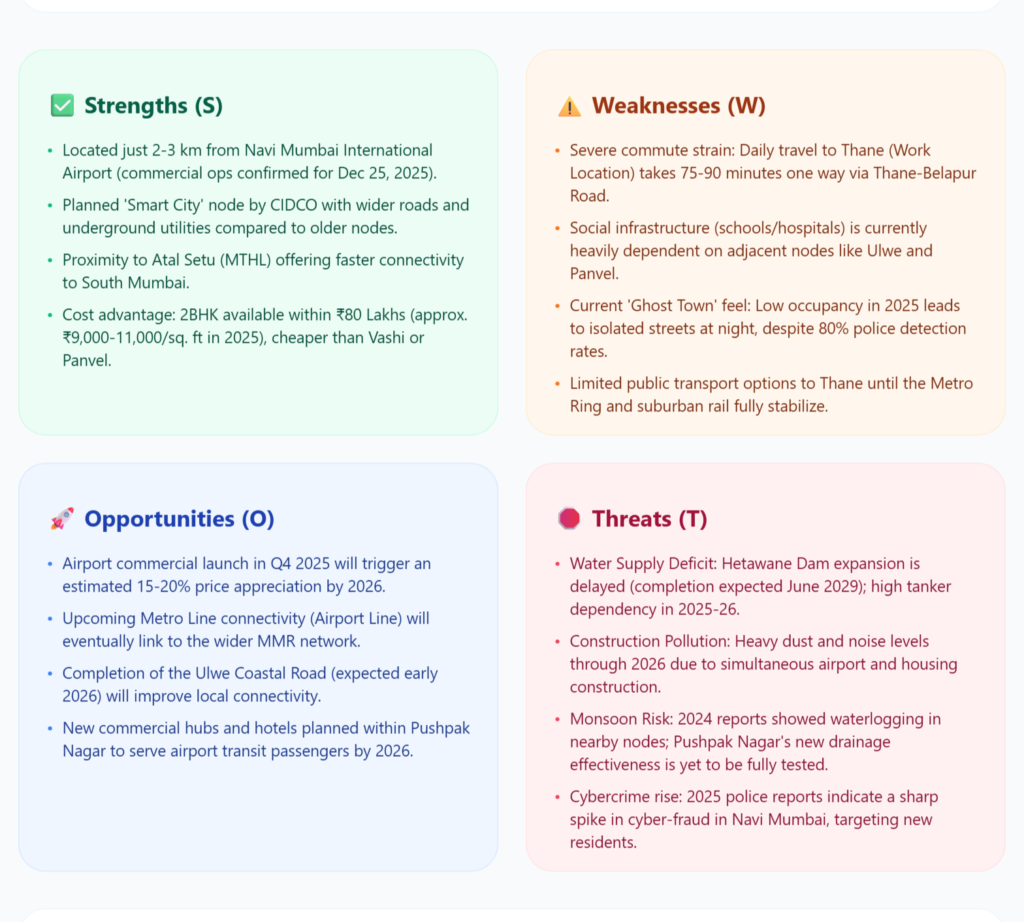
SWOT REPORT
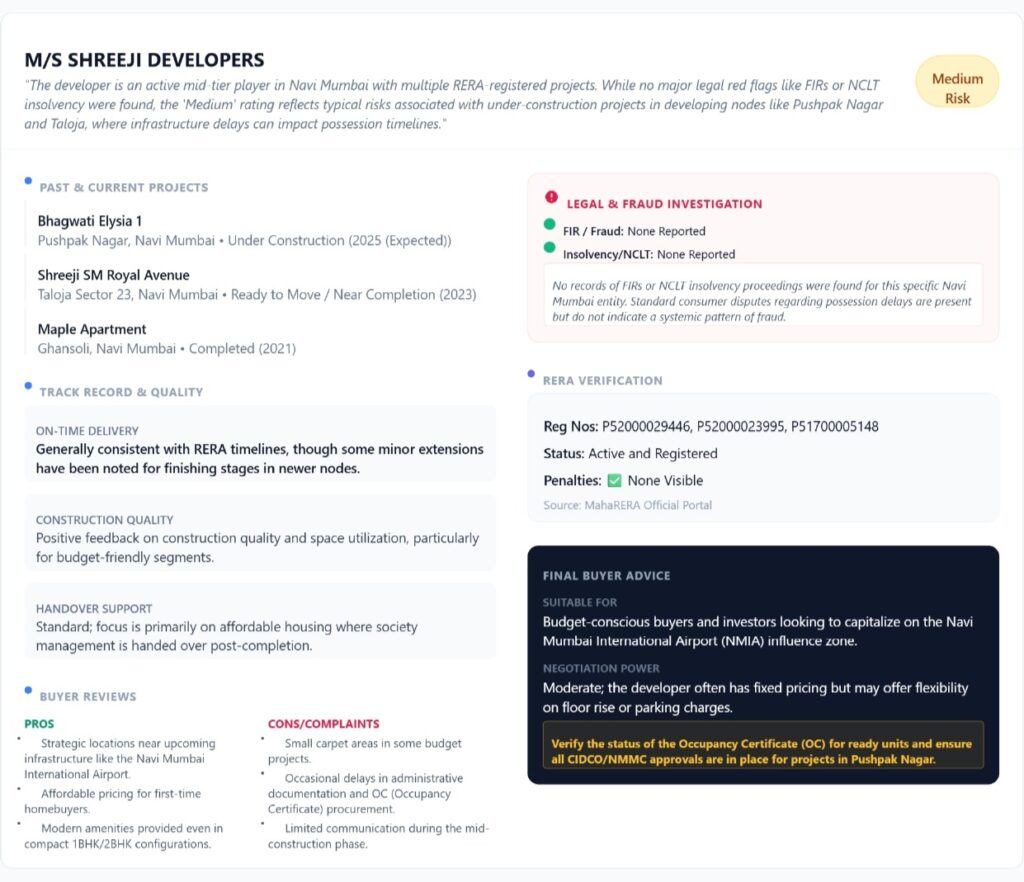
Then Builder Report
FLOOR PLAN LAYOUT ANALYSIS
Space Utilization
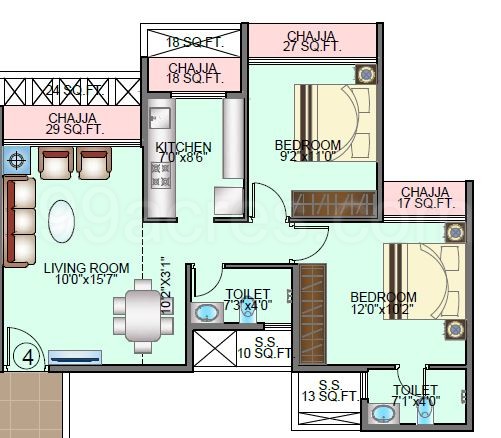
The floor plan is highly compact with a focus on maximizing utility over circulation space. The living room serves as the primary distribution hub, which minimizes hallway waste but creates a high-traffic zone in the center of the home.
Room Positioning
Standard 2BHK zoning with the living and dining areas occupying one half and bedrooms the other. The kitchen is centrally located, which is efficient for serving but can lead to heat and odor dispersal into the living zone.
Privacy Control
The bedroom wing is well-segregated from the main living area, offering good internal privacy. However, the main entry lacks a foyer, meaning the entire living room is exposed immediately upon opening the front door.
Light & Ventilation
Excellent for a small unit. Every habitable room, including the kitchen, has an attached ‘chajja’ or window opening. This suggests good potential for cross-ventilation and ample natural light penetration across the layout.
Noise Impact
The placement of the common toilet adjacent to the dining area may lead to acoustic discomfort. Additionally, the shared wall between the two bedrooms could result in sound transfer if not properly insulated during construction.
Daily Living
The living room’s 10-foot width is the minimum threshold for comfort; once a sofa and TV unit are placed, walking space becomes tight. The parallel kitchen platform is a functional choice for modern appliances and workflow.
Key Strengths (Pros)
- Abundant external openings and chajjas ensure superior natural light and ventilation in all rooms.
- Dedicated service slabs (S.S.) for AC outdoor units prevent unsightly pipework and ease maintenance.
- Efficient parallel kitchen layout provides more counter space than typical L-shaped designs in small apartments.
- The master bedroom is decently sized at 12’0″ x 10’2″, accommodating a king-size bed and wardrobe comfortably.
Drawbacks (Cons)
- The common toilet entry is directly visible from the dining and living areas, which is poor for social etiquette.
- Living room width of 10’0″ is restrictive for larger furniture sets or home theater setups.
- The second bedroom is quite small (9’2″ x 11’0″), making it better suited as a children’s room or study than a standard guest room.
- Lack of a dedicated foyer or entrance lobby reduces the ‘buffer’ between the public corridor and private living space.
Ideal Audience
A nuclear family or young couple looking for a functional, well-ventilated starter home in a high-density urban area.
Fire Safety Analysis
Fire Safety Quick Check Report
Building Type: Apartment (High-rise)
Floors: 12
Flats per floor: 11
1) Staircase Safety
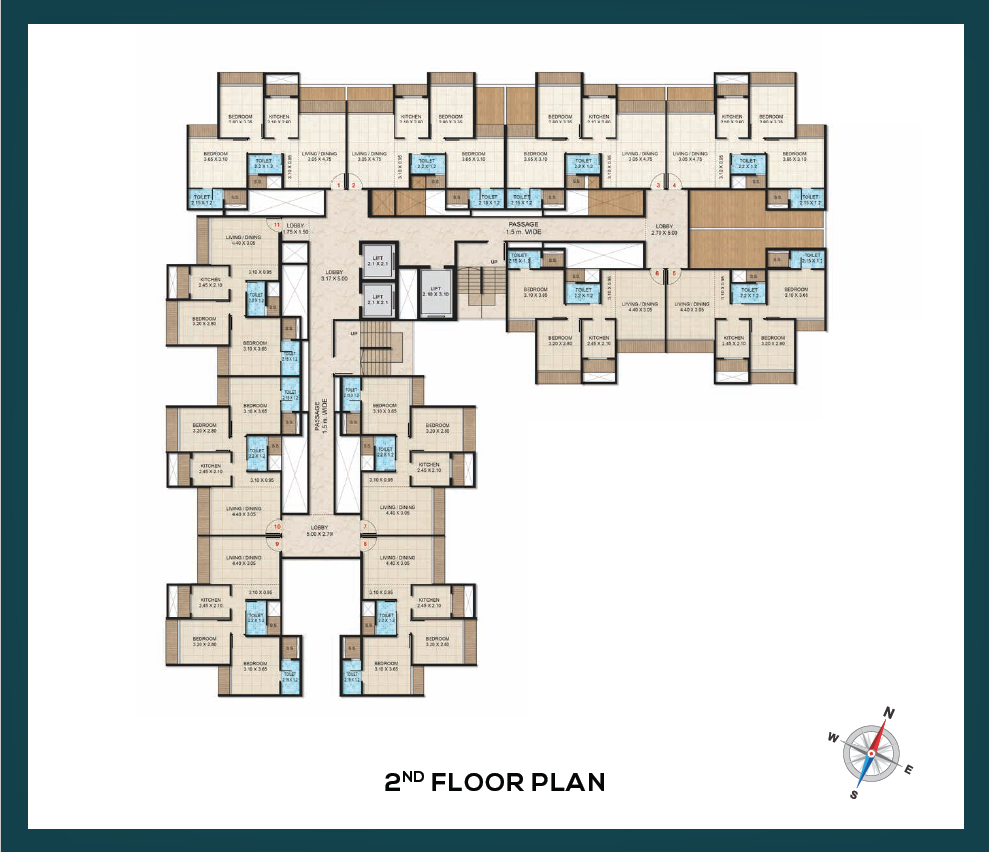
Two staircases are provided, which is mandatory for a building of this height and occupancy.
Proximity: The two staircases are located relatively close to each other in the central core. In an ideal “remote exit” design, they should be further apart to ensure that if one is blocked by smoke/fire, the other remains reachable. Buyer should confirm: Are the staircases “enclosed” with 2-hour fire-rated walls and Fire Check Doors (FCD)? Open staircases in high-rises act as chimneys for smoke.
2) Escape Route & Corridor Safety
Corridor Width: The passage is marked as 1.5m wide. While this meets the bare minimum for many local codes, for a high-density floor (11 flats), this may cause “bottlenecking” during a panicked evacuation. Dead-End Corridors: Flats 1, 2, 3, and 4 are located in “dead-end” pockets. If a fire starts in the lobby area, residents in these flats have no alternative escape route. Buyer should confirm: Ensure the corridors are kept 100% clear of shoe racks or potted plants, as 1.5m leaves zero room for obstruction.
3) Lift Lobby Safety
3 Lifts are provided, which is good for a 12-floor building with 11 units per floor. Lobby Integration: The lift lobby is directly connected to the main corridor. Without a smoke-stop lobby or pressurized shafts, smoke can easily enter the lift shafts and spread to other floors. Buyer should confirm: Is at least one lift designated as a “Fire Lift” with an independent power supply and toggle switch for firemen?
4) Secondary Exit / Fire Exit
Dual Access: Most flats have a relatively short travel distance to at least one of the two staircases. The “Middle” Trap: Flats 1, 2, and 11 are very close to the lifts/stairs, which is good for exit but bad if the fire originates in the electrical shafts usually located in the central core. Buyer should confirm: Do both staircases lead directly to an open area on the ground floor without passing through a basement or a locked gate?
5) Parking / Stilt Floor Risk
Basement Parking: Basements are high-risk zones due to car fuel and lack of natural ventilation. Buyer should confirm: Does the building have a functional sprinkler system in the basement? Are the staircase exits in the basement separated from the residential staircase via a fire-rated lobby? 6) Smoke Ventilation Logic
Internal Corridor Risk: The central corridor appears largely enclosed with limited natural cross-ventilation. In a fire, smoke is the primary killer. Buyer should confirm: Is there a Mechanical Smoke Extraction system (exhaust fans/ducts) for the internal corridors? Check if the “OTS” (Open to Sky) shafts are actually clear or blocked by grills.
Fire Safety Score: 6/10
Final Buyer Advice
Best safety strength: Provision of two staircases for a mid-sized high-rise. Biggest concern: High density (11 flats/floor) combined with narrow 1.5m corridors and “dead-end” layouts for corner flats. Who should avoid this building: Elderly residents or those with mobility issues should avoid the “dead-end” units (Flats 1, 2, 3, 4) as they have the most restricted escape paths. Mandatory Disclaimer:
This is a quick fire-safety layout screening based on visible plan details. Final safety depends on fire NOC, staircase enclosure, fire doors, sprinklers, hydrants, alarms, smoke extraction, and actual site execution. Please consult a licensed fire safety expert/engineer before purchase.
Society Crowd Load Score Report
1) Society Details
Total Flats: 118
Estimated Population: 472
Towers: 1
Floors per Tower: 12
Flats per Floor: 11
2) Society Crowd Load Score
4.8/10
Meaning: Overcrowded feeling
The society is categorized as overcrowded. The high density of 11 flats per floor combined with a significant parking shortage creates a cramped living environment that struggles to meet the convenience needs of a family.
3) Bottleneck Risk Breakdown
Lift Crowd Risk: Medium Risk
Three lifts for 12 floors is statistically acceptable, but with 11 flats per floor, peak hours will see significant wait times.
Parking Congestion: High Risk
There are only 89 slots for 118 flats. This means roughly 25% of owners will have no parking, and zero visitor parking will lead to street congestion.
Entry & Security Load: High Risk
Four guards across two gates usually means only one guard per gate per shift. With 472 residents, they will be overwhelmed by delivery and guest checks.
Amenity Crowd: High Risk
A population of nearly 500 people sharing a single gym and no pool will lead to heavy wear and tear and lack of privacy.
Service & Garbage: Low Risk
Garbage management is rated good, and there is a dedicated service lift to keep move-ins separate from daily traffic.
4) Suitability
Best For:
Budget-conscious individuals or small families who do not own a car and rely on public transport. Not Ideal For:
Families who prioritize convenience, own multiple vehicles, or frequently host guests.