
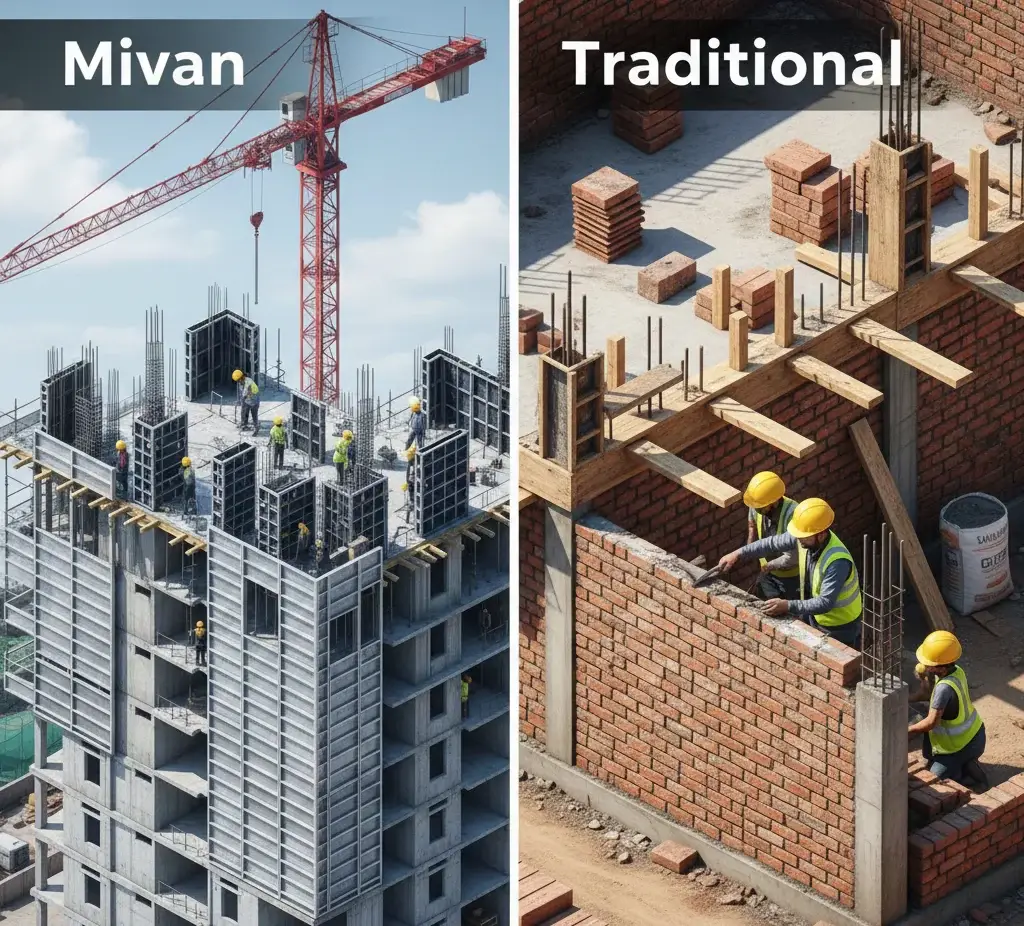
Most buyers ask whether a project uses Mivan or traditional construction?. However, very few ask the critical follow-up question: “How will this affect my daily life 5–10 years from now?” As a civil engineer, I want to share the uncomfortable truth behind these methods.
The Common Misconception
Buyers often assume that Mivan is premium and traditional is old school. In reality, builders choose construction systems based on speed and cost control rather than long-term resident comfort.
Mivan Construction Realities
Mivan (aluminium formwork) creates monolithic concrete walls. While it is structurally strong, the living experience is different. Common issues include hairline cracks across long walls, which are structurally normal but visually irritating. Concrete also retains more heat, leading to higher AC usage. Sound travels more easily between units, and any electrical changes require drilling into RCC, which is both risky and expensive. There is also zero flexibility for future layout changes. While nothing is structurally wrong, comfort often takes a hit.
Traditional Construction
This method uses brick or block walls with an RCC frame. It is not as fast or flashy, but it offers better thermal comfort and sound insulation. Repairs and electrical or plumbing changes are much easier to execute. It is also more forgiving if the initial workmanship is not perfect. This is why older apartments often feel cooler and quieter even today.
Mivan walls tend to crack visually rather than structurally. Concrete stores heat longer than brick. Modification rules after possession are significantly stricter in Mivan buildings, and repair costs are higher because mistakes are harder to fix. Builders rarely explain this because it could slow down sales.
Instead of simply asking if a building is Mivan, ask how heat insulation is handled. Inquire about the wall thickness and what modifications are allowed post-handover. Ask how cracks are treated after possession. If the answers are vague, that is your answer.
There are costs that many fail to calculate, such as higher electricity bills and increased interior modification expenses. There is also lower flexibility for future resale buyers and a higher dependency on machines like ACs, drilling tools, and pumps. These seem like small things until you live there daily.
Mivan is excellent for speed and strength, while traditional construction is better for comfort and flexibility. Neither is inherently bad, but buying blindly is a mistake. I am sharing this because most people only learn these details after spending 1–2 crore. If this helps even one buyer ask better questions, it is worth sharing.