
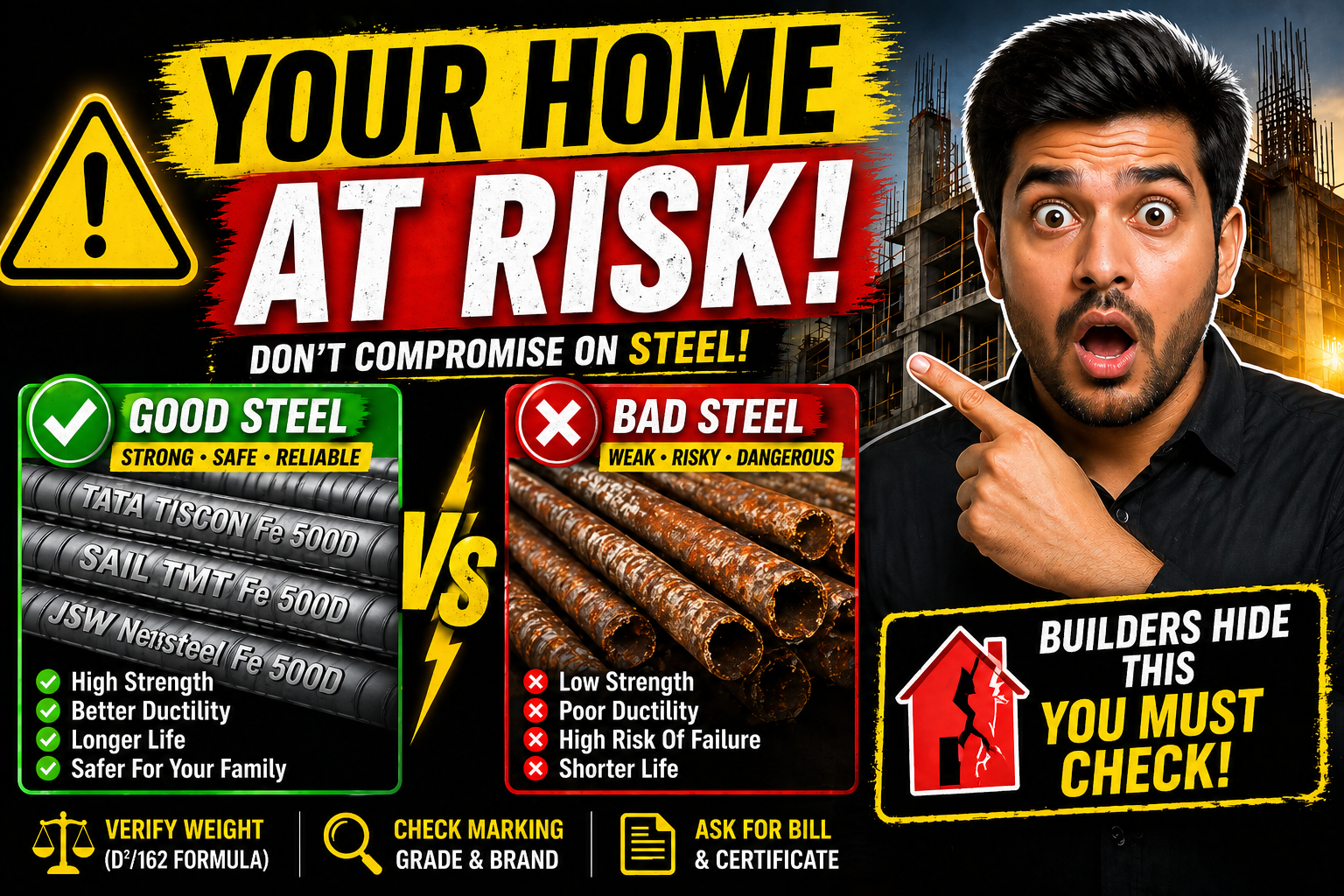
You walked into that flat and everything looked right. Smooth walls. Vitrified tiles. A modular kitchen with premium fittings. The sales pitch was polished, the brochure was glossy, and the price tag made your heart race but in a good way. This is it, you thought. This is the one.
Here’s what nobody told you that day:The most critical part of your ₹90 lakh home is buried inside concrete walls you can never look inside. It’s called steel and if your builder cut corners on it, your beautiful flat may develop cracks earlier than it should, lose structural strength over time, and in worst-case scenarios, become a safety liability. The frightening part? You’d have no way of knowing. Not on possession day. Not five years later when the cracks start appearing. By then, your money is gone and your legal options are limited. This post is your protection against that outcome.
Why Steel Is the One Thing Buyers Never Ask About
Walk into any site office and ask a buyer what grade of tiles the builder is using. They’ll tell you. Ask about the lift brand. They’ll tell you. Ask about the paint finish. They’ll pull out the specification sheet. Now ask them: “Kaunsa steel use ho raha hai structure mein?” Silence. And that silence is exactly what builders count on. Most buyers assume steel is steel that all the bars stacked at a construction site are roughly the same. They’re not. Two buildings can both claim to use “Fe500 grade TMT steel” and have dramatically different structural quality. One uses primary branded steel made from iron ore with consistent manufacturing standards. The other uses secondary (scrap-based) steel where strength and ductility vary bar to bar. Same label. Very different building.
There are three reasons buyers stay blind to this:
- “Steel toh sab same hota hai” -This is the single most dangerous assumption in Indian real estate. Grade markings can be replicated. Invoices can be manipulated. Without physical verification, you have no way to confirm what’s actually been poured into your slabs.
- “Mujhe technical knowledge nahi hai”-Builders rely on this gap. The less you understand, the easier it is to substitute cheaper materials without resistance.
- “Builder pe trust karna padta hai”-India’s real estate ecosystem is not built on trust. It’s built on information asymmetry. Whoever has more information wins. Right now, the builder always wins. But not after you read this.
What Steel Actually Does and Why Getting It Wrong Is Catastrophic
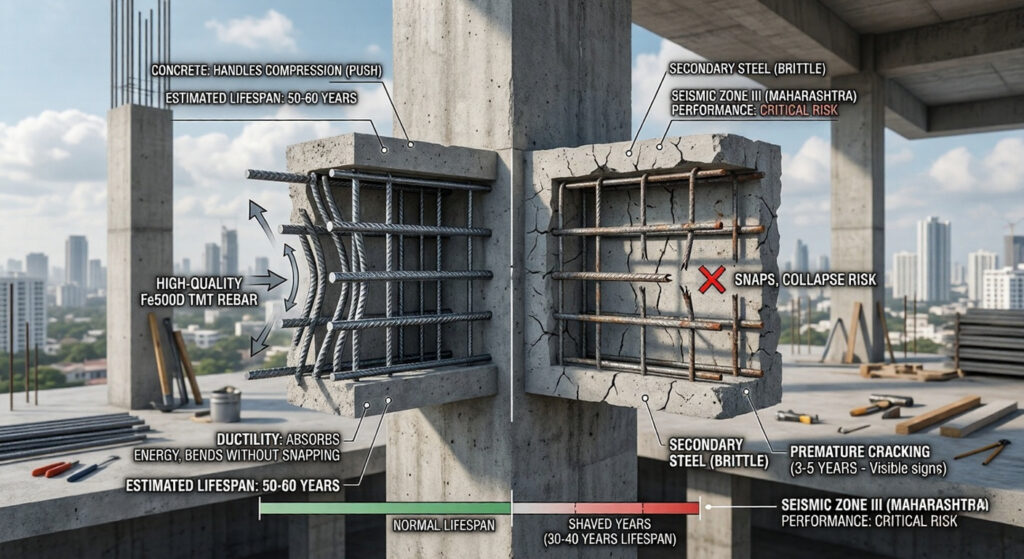
Your building’s columns, beams, slabs, and shear walls all rely on one thing: reinforced concrete. Concrete handles compression (being pushed together). Steel handles tension (being pulled apart). Remove quality steel from that equation and you’ve essentially built a structure that can handle only half the forces it will face over its lifetime.
Here’s what that means practically:
- Cracks appear earlier than they should. Hairline cracks within 3–5 years of possession are often the first visible sign of compromised steel or incorrect quantity used in construction.
- The building ages faster. A structure built with proper Fe500D TMT from a primary producer is designed for a 50–60 year lifespan. Secondary steel can shave years off that quietly, invisibly.
- Seismic performance drops. This one matters in Maharashtra. Mumbai and surrounding regions fall in Seismic Zone III. In an earthquake, the ductility of your steel its ability to bend without snapping is what gives a building the ability to absorb energy rather than collapse suddenly. Low-ductility steel in Zone III is not a theoretical problem. It’s a real one.
All structural steel in residential buildings in India is TMT steel Thermo-Mechanically Treated bars. The grades you’ll encounter are:
- Fe 415 -Moderate strength. Still used in small residential projects and older constructions. Acceptable, but not the preferred choice for modern multi-storey buildings.
- Fe 500 / Fe 500D-This is the standard for modern residential buildings. Fe500 offers good strength. Fe500D adds ductility the “D” literally stands for Ductile. For your home, Fe500D is the minimum you should expect and demand.
- Fe 550 / Fe 600 -Very high strength grades used in large infrastructure projects: bridges, dams, industrial structures. You’re unlikely to encounter these in a residential project, and if a builder claims they’re using Fe550 throughout a housing society, treat that claim with suspicion.
The simple rule: Ask specifically for Fe500D. If your builder is using Fe415 in a multi-storey building, ask why. If they can’t explain it, that’s a red flag.
The Hidden Divide: Primary Steel vs Secondary Steel This is the distinction most buyers never learn and it’s where the real cheating happens.
- Primary steel is manufactured from iron ore using a controlled industrial process. The output is consistent: predictable strength, verified ductility, traceable batch numbers. Brands like Tata Tiscon, SAIL TMT, and JSW Neosteel are primary producers. Their steel comes with manufacturer test certificates. You can verify the grade against national standards (IS 1786).
- Secondary steel is made from scrap metal recycled from old vehicles, machinery, demolished structures. Scrap composition varies, which means the output varies. A secondary steel bar marked Fe500 may not actually meet Fe500 standards throughout its length. The ribs (the ridges on the surface) may not be uniform. The weight may be below specification. Secondary steel is significantly cheaper. That cost saving goes directly into the builder’s margin not into your home’s safety. Here’s the brutal reality: there is no regulation that makes it illegal to use secondary steel in residential construction, provided it passes lab tests. But lab tests require representative samples, and unscrupulous suppliers know how to present better bars for testing. Once the concrete is poured, nobody can tell what’s inside. This is why verification must happen before the concrete is poured which is exactly the window most buyers never know they have.
Four Ways to Verify Steel Quality Before It Disappears Into Concrete
You don’t need a civil engineering degree to do this. You need to visit the site during construction ideally after the reinforcement is placed and before concreting begins. Here’s what to check:
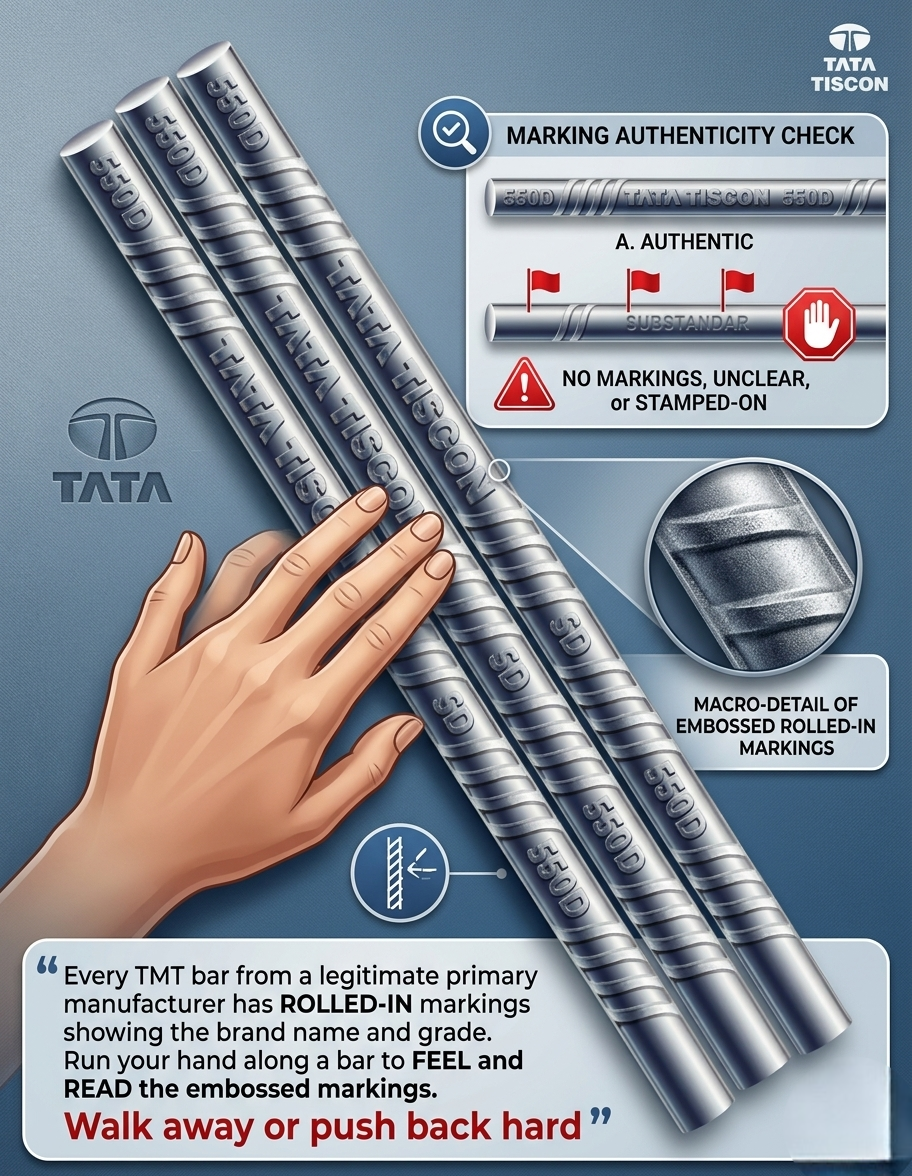
- Look at the markings on every bar
Every TMT bar from a legitimate primary manufacturer has rolled-in markings showing the brand name and grade. Run your hand along a bar. You should be able to feel (and read) the embossed markings: the producer’s logo, and “Fe500” or “Fe500D.” No markings, unclear markings, or markings that look stamped-on rather than rolled-in are red flags. Walk away or push back hard. - Check the weight using a simple formula
This one is powerful. Every TMT bar has a theoretical weight per metre based on its diameter. The formula is:
Weight (kg/m) = D² ÷ 162
Where D is the diameter in millimetres. So a 12mm bar should weigh 0.89 kg per metre. A 16mm bar should weigh 1.58 kg per metre. If you weigh a 1-metre sample from the site and it comes up short, the bar is underweight which means its cross-section is smaller than specified, which means it’s weaker than specified. Builders who buy secondary steel often get underweight bars, and they count on buyers never checking. Carry a tape measure and a kitchen scale to the site. It takes five minutes. - Demand the purchase invoice
Ask the builder’s site engineer to show you a recent steel purchase invoice. A legitimate invoice will show the supplier’s name, the brand (Tata Tiscon, JSW, SAIL etc.), the grade, quantity, and price. If the invoice shows an unknown brand name or the engineer is evasive, you know why. This is your right. You’re a buyer. You’re not asking for trade secrets you’re asking for documentation about a material that will determine whether your family is safe in their home for the next 50 years. - Visual inspection of the ribs
Run your eye along several bars. On quality TMT steel, the transverse ribs (the diagonal ridges that give rebars grip in concrete) are uniform in spacing and height. On poor-quality secondary steel, ribs are often uneven, missing in places, or covered in flaky rust that goes deeper than surface oxidation. A little surface rust on TMT bars stored outside is normal it actually improves bonding. Flaky, deep rust that you can scrape off in layers is not. That’s a sign of poor manufacturing or improper storage.
The Question You Need to Ask Before You Sign Anything
Here’s the uncomfortable truth about your builder agreement: it almost certainly does not specify the steel brand. It may specify the grade (Fe500), but it will not say Tata Tiscon or JSW Neosteel. This gap is intentional. It gives builders legal cover to use whatever steel they want, as long as they can claim it meets the grade specification. Before you sign, push for a specification addendum. Ask your builder to commit in writing to:
- The grade of steel being used (minimum Fe500D)
- Whether it’s primary or secondary manufactured steel
- The brand name
- Submission of manufacturer test certificates for each consignment
Most builders won’t agree to all four. But the negotiation itself tells you something. A builder who is genuinely using quality steel has nothing to lose by putting it in writing.
What You’re Actually Buying
When you write that cheque, you’re not buying tiles. You’re not buying paint or a modular kitchen or a gym on the 4th floor. You’re buying a reinforced concrete structure that your family will live inside for decades. Your children will grow up in it. Your parents will grow old in it. It needs to handle monsoon seasons, seismic events, and the slow accumulation of dead loads over 50 years. That structure’s integrity comes down to the quality of steel inside it steel you can never see once the formwork comes off. Builders know this. Smart buyers need to know it too.
Before your next site visit, write down three questions:
- “Kaunsa steel brand use ho raha hai?”
- “Fe500D hai ya sirf Fe500?”
- “Manufacturer test certificate dikha sakte ho?”
You don’t need to know more than that to start the right conversation. And if the builder can’t answer those three questions clearly, you already have your answer.
Don’t take chances with your biggest investment.
We provide professional inspection services & Pre-Purchase Evaluation to help you verify before you decide.