
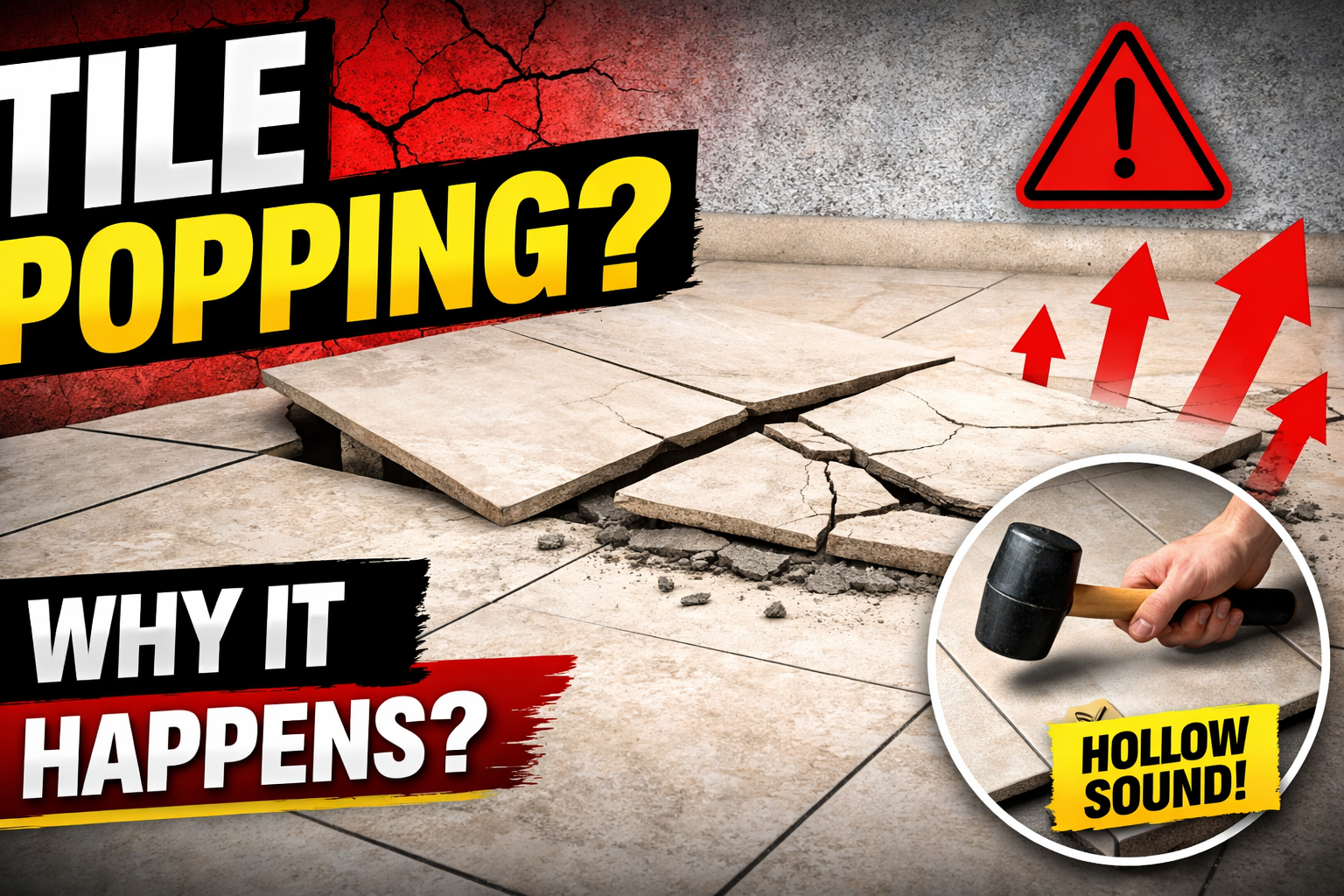
You paid lakhs for that flat. You watched the finishing work happen. You moved in, feeling proud. Then one morning crack. A tile lifts. Another one sounds hollow when you tap it. And suddenly you’re wondering if your dream home is falling apart from the floor up.
Here’s the hard truth: tile popping is not bad luck. It is almost always bad construction. And if you know what caused it, you have every right to make your builder fix it at zero cost to you. Let me explain exactly what’s happening under your floor, why builders get away with it, and what you can do about it right now.
The Real Reason Tiles Pop (It’s Not What You Think)
Most people assume tiles pop because of poor quality tiles. That’s rarely the case. The tiles are fine. The problem is what’s happening underneath them. When a tile is laid, it needs to be fully bonded to the floor bed below it no gaps, no voids. When that bond breaks, the tile sits on air. Tap it and you’ll hear a hollow, drum-like sound. Leave it long enough and it cracks or pops up entirely. The bond breaks for a few specific reasons and every single one of them is a workmanship or design failure:
- No expansion joints were left. This is the #1 cause in Indian residential construction. Tiles like all materials expand and contract with heat. If there’s no gap left between tiles or at the room edges, thermal stress builds up with nowhere to go. Eventually the tiles are forced upward. This is especially common on west-facing terraces and top-floor flats.
- Insufficient or uneven mortar bed. If the mortar under the tile is too thin, unevenly spread, or has voids, there’s nothing holding the tile down when stress hits. The RCC/BIS standard requires at least 80% full contact between tile back and mortar most contractor teams never verify this.
- The screed beneath was weak. If the base on which tiles were laid wasn’t properly cured or mixed, the screed itself crumbles over time and the tile bond breaks with it. You can have perfect tiles on a failing base and it won’t matter.
- Wet tiles or wet substrate. Moisture from a leaking bathroom above, water seeping through a terrace, or rising dampness in the slab weakens the mortar bond silently over months. By the time you see a popped tile, the damage is already widespread.
- Tiles were laid dry. Ceramic tiles must be pre-soaked before laying so they don’t pull water out of the fresh mortar and prematurely dry it. This step gets skipped constantly on busy sites.
How to Check If Your Floor Is Already Affected
You don’t need an engineer for this. Take a coin a ₹5 or ₹10 coin works well and tap across your floor, row by row. A properly bonded tile gives a solid, dull thud. A debonded tile gives a hollow, ringing tap-tap-tap. You can hear the difference immediately. Mark every hollow tile with a chalk mark or tape. Then count. Fewer than 5 tiles: Localised repair is straightforward. Multiple tiles in one zone: Likely a moisture issue or settlement needs investigation before repair. Tiles popping across the whole floor: The entire laying was defective. This is a builder defect, full stop.
How to Get This Repaired Without Spending Your Own Money
If your flat is within the defect liability period, you don’t have to spend a single rupee on this. Under RERA (Real Estate Regulation and Development Act), Section 14(3) makes builders responsible for repairing structural defects including workmanship defects like tile debonding for 5 years from the date of possession. Tile popping caused by missing expansion joints, poor mortar coverage, or weak screed absolutely falls under this.
Step 1: Document everything. Photograph every popped or hollow tile. Note the date. Capture video of the coin-tap test so the hollow sound is on record. Do this before anything is repaired or shifted.
Step 2: Write to the builder formally. Send a written complaint to the builder’s customer care or site office. Put it in writing not just a phone call or WhatsApp. Email is fine if you have a trail. Mention RERA, defect liability period, and the specific dates of possession. Keep a copy.
Step 3: Give them a reasonable window. Builders typically get 30 days to respond and 60–90 days to carry out repairs. State this expectation clearly in your communication.
Step 4: Escalate to RERA if ignored. If the builder ignores you or refuses, file a complaint with your state’s RERA authority. This is simpler than most home buyers realise. The process is online in Maharashtra (MahaRERA), Karnataka, UP, and most other states. Attach your possession letter, your written complaint to the builder, and your photo documentation. Builders take RERA complaints seriously. It costs far less for them to send a tiling team than to fight a formal complaint. If You’re Paying for the Repair Yourself: Do It Right This Time
If the building is older, the defect liability period has passed, or you’re dealing with a builder who simply won’t cooperate here’s how to repair it properly so it doesn’t happen again in two years. For 1–3 isolated hollow tiles (tile intact, not cracked): Use the epoxy injection method. Drill 3–4 small holes (6–8 mm diameter) in the tile, inject low-viscosity epoxy adhesive with a syringe, plug holes with matching grout. This saves a tile you can’t easily replace useful for marble, designer tiles, or imported finishes.
For loose but intact tiles: Remove carefully using a chisel and rubber mallet work from the edges inward to avoid cracking. Chip away all old mortar from both the tile back and the floor substrate. Clean thoroughly. Re-lay with polymer-modified tile adhesive (products like LATICRETE 254, Weber.set Rapid, or Pidilite’s Dr. Fixit TileFix) rather than plain cement mortar. These adhesives flex slightly, which is exactly what prevents future popping.
For widespread failure: Strip the entire area. Before re-tiling, fix the root cause waterproof the substrate if there’s moisture, address any slab cracks or settlement, ensure the screed beneath is sound. Then re-lay with polymer adhesive, full coverage, and proper expansion joints (2–3 mm between tiles, a perimeter joint where tile meets wall). Critical: Do not skip the expansion joints this time. This single omission is behind the majority of tile failures across India. Insist your contractor leaves them, and seal them with silicone not grout. What to Demand If You’re Still Under Construction
If your flat hasn’t been handed over yet and you’re at the tiling stage, this is the best time to act. Ask your site supervisor or builder:
- Are expansion joints being left between tile rows and at room perimeters?
- Is polymer-modified adhesive being used, or plain mortar?
- Are ceramic tiles being pre-soaked before laying?
- Will the tile coverage be checked to ensure at least 80% full contact? These are standard quality checks. A builder who bristles at these questions is telling you something important. The Bottom Line
Tile popping is not wear and tear. It is a construction failure one that is entirely preventable with the right materials, the right workmanship, and the right supervision. If it’s happened in your home, you are not helpless. You have documentation rights, RERA protection, and a clear repair path. Here’s your action step for today: Grab a coin and do the tap test on your floor especially near the windows, the kitchen, and the bathroom edges. Take a 60-second video of the hollow spots. Save it. That video is your evidence. If you find widespread debonding, write to your builder this week. Don’t wait. The 5-year defect liability clock is ticking.
Don’t take chances with your biggest investment.
We provide professional inspection services & Pre-Purchase Evaluation to help you verify before you decide.