
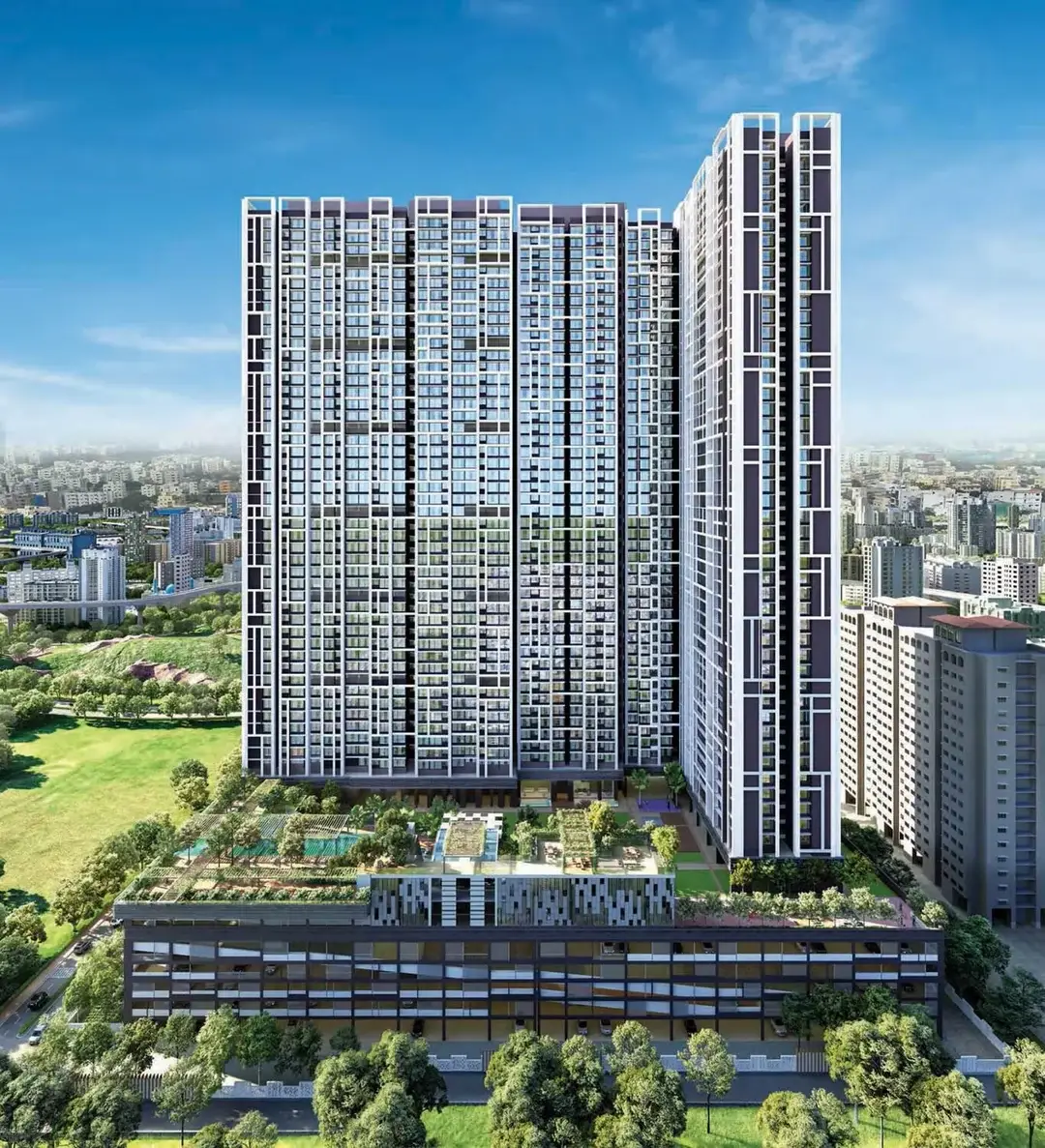
When you buy your first high-rise flat, especially on the top floors, some members of the family may feel that the building is swaying, while others may not feel anything at all. This often creates fear and confusion. However, swaying of a building within permissible limits is allowed as per IS 456 and IS 875 (Part 3 – Wind Loads). The following calculation provides a better understanding of these forces. All details, formulas, and references are available in IS 875 for verification. Building details (example)
Location: Mumbai Storeys: 40 Approximate height: 120 m Building type: Residential tower
Terrain: Urban area (Category 3)
Topography: Flat land
Step 1: Basic wind speed (IS 875 wind map)
From the IS 875 wind map:
Mumbai Vb = 44 m/s
This value is valid only at 10 m height in open terrain. Tall buildings experience higher wind speeds at top floors.
Step 2: Risk factor (k1)
Normal residential building
Design life = 50 years
k1 = 1.0
Step 3: Height and terrain factor (k2)
Terrain: Category 3
Height: 120 m
Structure class: Class C (> 50 m)
From IS 875 Table 2:
At 100 m k2 = 1.10
At 150 m k2 = 1.15
Interpolation for 120 m:
k2 = 1.10 + 20/50 * (1.15 – 1.10)
k2 = 1.12
Step 4: Topography factor (k3)
Flat land
No hill or ridge
k3 = 1.0
Step 5: Design wind speed at top floor
Vz = Vb *k1 * k2 * k3
Vz = 44 * 1.0 * 1.12 * 1.0
Vz = 49.3 m/s
This is the actual wind speed used for design, not the map value of 44 m/s.
Step 6: Wind pressure on the building
Pz = 0.6 * Vz^2
Pz = 0.6 * (49.3)^2
Pz = 1458 N/m² = 1.46 kN/m²
How much sway is allowed? As per IS 456 Indian practice:
Wind sway limit = Height / 500
For a 120 m building:
120000 / 500 = 240 mm
Typical actual sway is usually around 100–150 mm.
Feeling movement does not mean danger. High-rise buildings are designed to sway elastically. Wind safety does not equate to comfort perfection, and aerodynamic design is optional, not mandatory, in India.
When you purchase a flat in a high-rise building especially on the top floors be aware that slight sway due to wind forces is normal. Sensitive people may feel it more, but the building is safe and structurally sound. What you should really check is your personal comfort level.