
You finally book your flat. Good location. Good price. Good “earthquake-resistant structure.”
Then one night, a heavy trailer passes and you feel it,you feel vibration. It is not dramatic or scary, but it is noticeable. Suddenly your brain starts racing: Did I buy a weak building? Will cracks appear later? Will this affect resale? What if my family starts worrying? Did I ignore something important?
Let’s separate fear from facts. I’m a civil engineer, and here is what is really happening.
First: Vibration ≠ Structural Weakness
Modern RCC buildings are designed for earthquake forces, wind forces, and dead and live loads. Truck vibration is tiny compared to earthquake loading. If the building is designed properly, this vibration is well within safety limits. Your building is not about to fail.
But here is the part most salespeople won’t tell you: Safety is not the same as comfort. Buyers don’t complain about safety, they complain about comfort.
Why Does It Happen At All?
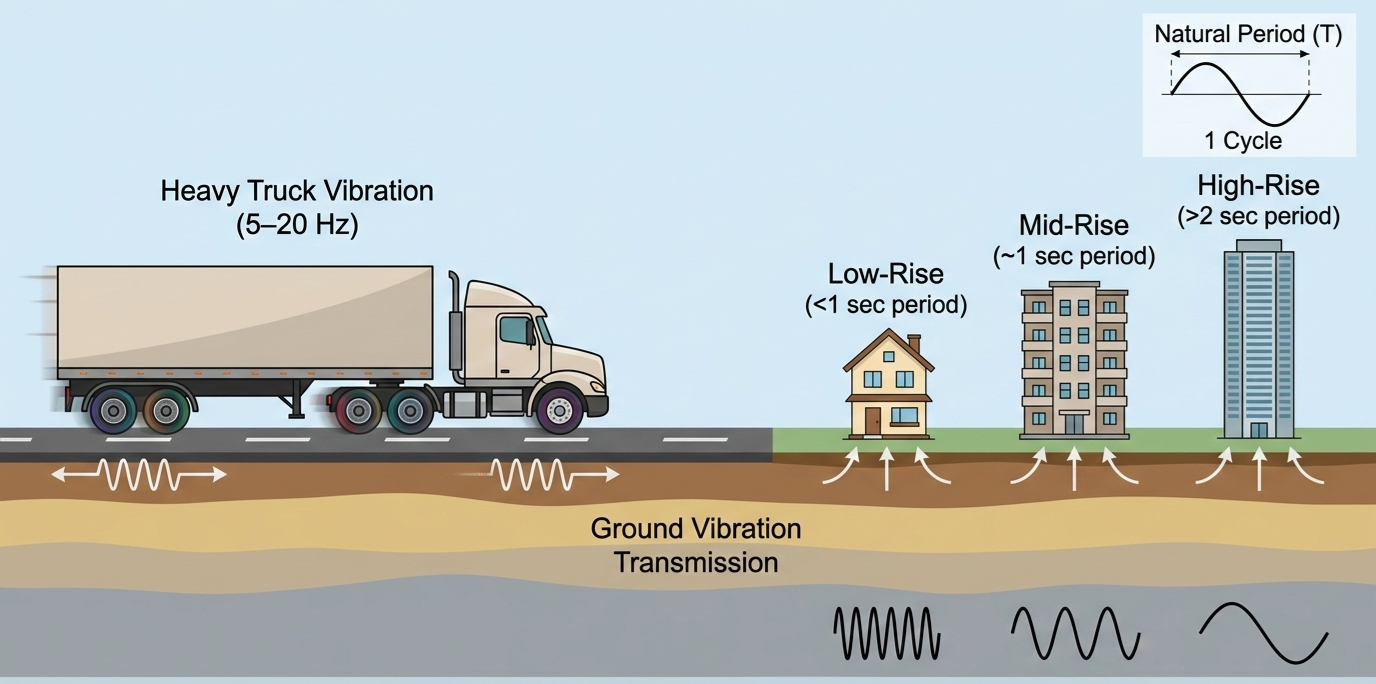
Every building has something called a natural frequency. Think of it like a swing. Push a swing once and it moves in its own rhythm. Buildings do the same. Engineers calculate this rhythm using two simple things: how heavy the building is and how stiff the structure is. Taller buildings are heavier and more flexible, while shorter buildings are stiffer.
Now here is the key: Trucks vibrate at a much faster rhythm than buildings move. That means there is no dangerous resonance and no structural failure. It is just a small physical response. It is safe, but sometimes felt.
Why Some Floors Feel Worse
This is where buyers make expensive mistakes. Ground floors feel vibration directly from the soil. Top floors feel amplified movement because height increases flexibility. Mid-lower floors experience the least noticeable movement.
Imagine a tree: the base is connected to the ground, the top moves most in the wind, and the middle is the most stable. Buildings behave the same way.
So Which Floor Is Smartest Near a Highway? If your building is close to a busy road:
Avoid the ground floor due to direct vibration transfer. Avoid very top floors due to maximum sway. Choose the middle floor for the best comfort balance. That is usually the sweet spot.
When Should You Be Extra Careful? Vibration feels stronger if the building is within 15–20 meters of a highway, if there is a flyover joint nearby, if the soil is soft or filled land, or if heavy trailers pass frequently at night. This is not about structure it is about long-term livability.
Before You Pay Token Visit during peak truck hours. Stand silently for 5 minutes. Notice window rattling, floor sensation, water ripples in a bottle, or bed vibration feelings. Don’t test at 2 PM when traffic is light. Test when reality happens. Ten minutes today can prevent twenty years of irritation.
Your building vibrating does not automatically mean bad construction, an unsafe structure, or future collapse. But ignoring comfort today can create sleep disturbance, family anxiety, regret, and lower resale appeal. Structure is about engineering. Home is about peace of mind. Choose your floor accordingly, because you don’t just buy concrete. you buy 20 years of daily experience.