
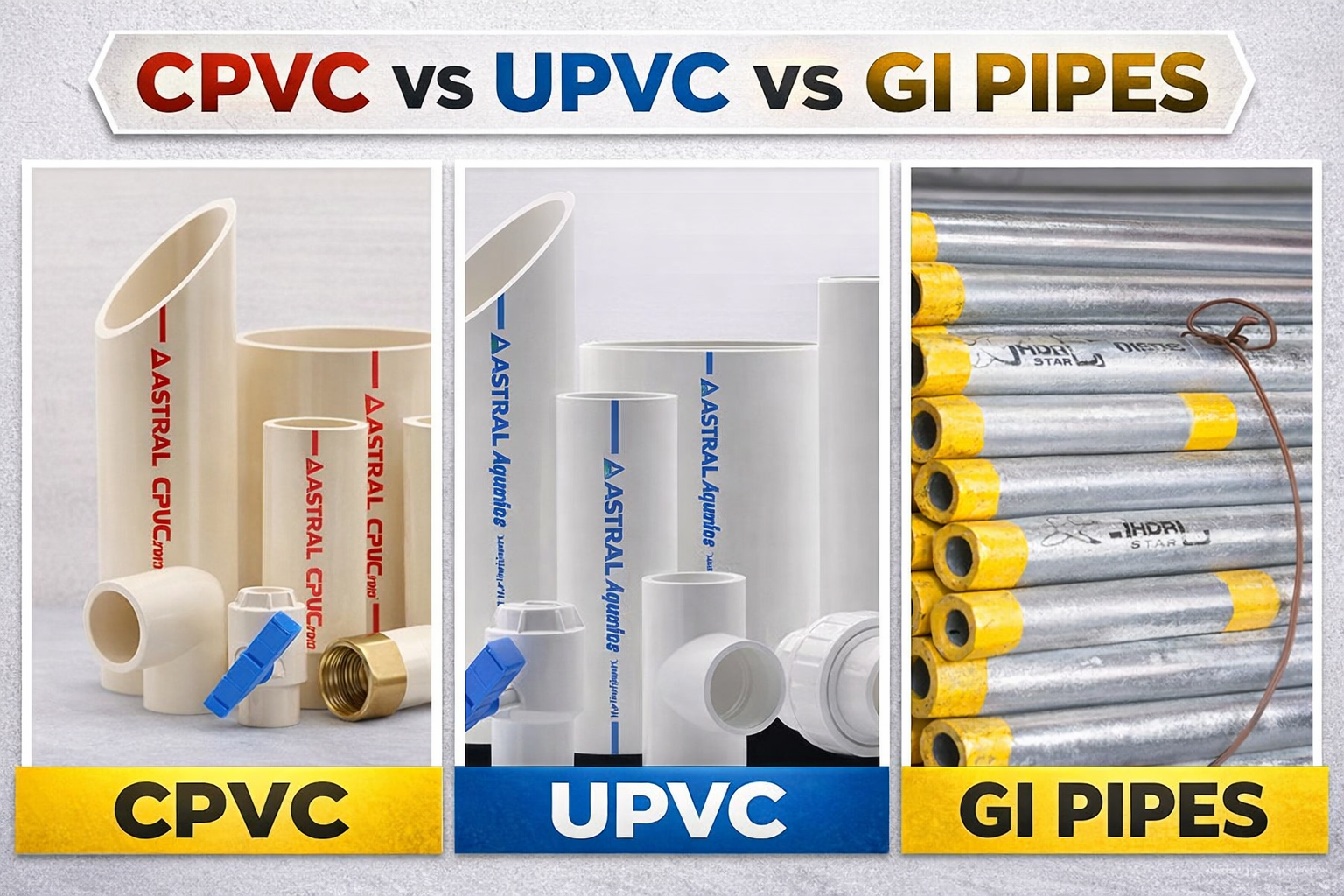
CPVC, UPVC and GI pipes are not the same thing. One will serve your family for 50 years. One will rust inside your walls. Your builder may have already decided which one goes into your home without telling you.
Most home buyers inspect tiles, check ceiling heights, and test light switches at the time of possession. Almost none of them ask what type of pipe is running inside their walls. Yet that single decision, made by the builder months before you moved in, will determine whether your water is clean or contaminated, whether your pipes last a decade or five decades, and whether you spend lakhs on a replumbing job ten years from now. By the time you discover the problem, the walls are shut and the builder is unreachable.
There is a very short, very important sentence buried in most project brochures. It usually appears under the heading “Specifications” and reads something like: Plumbing: ISI marked pipes as per standard practice. That sentence tells you almost nothing. And builders know it.
Because when a builder says “standard practice,” what they often mean is the cheapest option that passes inspection. Not the best option for your family’s health. Not the most durable option for your home’s lifetime. The option that saves them the most money per flat, multiplied across hundreds of units in the tower.
Understanding the difference between GI, UPVC and CPVC pipes takes about ten minutes. But that ten minutes of knowledge gives you the ability to ask the right question, get a straight answer, and walk away from a project if the answer is not good enough. That is the power you are about to have.
Here Is the Problem You Are Already Sitting In
Every flat in every building has two types of plumbing. The first is your drainage system, which carries wastewater out of the building. The second is your supply system, which brings fresh water into your kitchen, bathrooms, and every tap in your home.
The supply system is the one that matters most for your family. It is also the one where the pipe choice has the most dramatic impact on your health, your maintenance costs, and the long-term value of your home.
Three pipe materials dominate residential construction in India today: GI (Galvanised Iron), UPVC (Unplasticised Polyvinyl Chloride) and CPVC (Chlorinated Polyvinyl Chloride). They look similar on a plan. They look similar on a site visit. But they are completely different materials with completely different consequences for you and your family.
“The pipe inside your wall will never change unless you break the wall open. Whatever your builder chose, you will live with that choice for the entire time you own that home.”
Now imagine this. Five years after possession, your kitchen water starts running slightly discoloured in the mornings. You ignore it for a few weeks. Then you notice a faint metallic smell. You call a plumber. He tells you the GI pipes inside your walls have started to corrode, as they always do after a few years of use. To fix it properly, you need to break open two kitchen walls, a bathroom wall, and part of the corridor. The replumbing job alone will cost somewhere between two and four lakhs. The tile and wall repair afterwards will cost more. You had no idea when you were buying that the builder had used a pipe material that engineers have been moving away from for two decades.
That is not a horror story. That is a Tuesday conversation in thousands of households across India.
Average lifespan of GI pipes in hard water zones before corrosion becomes a visible problem
Design lifespan of a good CPVC plumbing system with standard maintenance
Typical replumbing cost in a 2BHK including wall breakage and restoration
And here is what makes it worse. When you ask the builder at the time of booking, most will simply say “ISI marked pipes” or “as per specification.” They will not tell you the material unless you know to ask. They have no legal obligation to disclose it in the brochure. And by the time the building is occupied and you discover the issue, the developer has already moved on to the next project. You are on your own.
Luckily For You, There Is a Simple Way to Know Exactly What to Ask
The good news is this. Once you understand what GI, UPVC and CPVC actually are, you can ask a single direct question during any site visit and get an answer that tells you everything about how seriously that builder takes your long-term wellbeing.
Here is what each pipe material actually means, in plain language.
- Metal pipe with zinc coating
- Heavy and rigid
- Used in India for decades
- Corrodes from inside over time
- Rust affects water quality
- Poor in hard water zones
- Difficult to repair inside walls
- Rigid plastic pipe
- Excellent for drainage lines
- Light and easy to install
- Not suitable for hot water
- Softens above 60 degrees C
- Good chemical resistance
- Low cost for waste lines
- Chlorinated plastic pipe
- Handles hot and cold water
- Safe for drinking water supply
- Does not corrode or rust
- Rated up to 93 degrees C
- 50 year design life
- Lightweight and low maintenance
Here is what choosing CPVC for your building’s supply plumbing actually means for your day-to-day life:
-
1CPVC does not corrode or rust from the inside, so you get clean water from every tap in your home which means your family never has to wonder whether the brownish morning water is safe to cook with or give to your children.
-
2CPVC handles hot water up to 93 degrees Celsius, so your geyser output runs through safe, rated pipe all the way to the shower and sink which means you never have to worry about softened or deformed supply lines inside your bathroom walls.
-
3CPVC pipes have a 50-year design lifespan, so your plumbing outlasts every renovation, every kitchen upgrade, and every future sale of your property which means your home retains its value instead of coming with an asterisk on the inspection report.
-
4CPVC is lighter and easier to work with than GI, so any future repair or extension can be done without major wall damage which means a plumbing issue ten years from now becomes a one-day job instead of a two-week renovation nightmare.
-
5A builder who specifies CPVC for supply lines demonstrates that they designed the building for the lifetime of the resident, not the cost sheet of the project which means you are getting a builder who makes the harder, more expensive choice when it serves you, even when no one will notice at possession.
Imagine What Your Life Looks Like With the Right Pipe in the Wall
- Rust appears in morning water
- Metallic smell from kitchen tap
- Walls broken open for replumbing
- Three to four lakhs unbudgeted
- Builder unreachable, problem is yours
- Clean water from every tap, always
- No corrosion, no contamination
- Walls stay closed for 50 years
- Zero unplanned plumbing spend
- Home value protected at resale
The bridge between those two realities is a single question you ask at the site visit before you sign anything. It costs you nothing to ask. The answer costs the builder either a decision or their credibility.
The Five Questions to Ask Your Builder Before You Sign
You do not need to carry a technical manual. You need these five questions. Write them in your phone. Ask them at every site visit. Watch how the builder responds, because the response itself is data.
-
Q 1
What pipe material is used for internal water supply lines? Ask them to specify: GI, UPVC or CPVC. Accept no vague answer about “ISI marked pipes” because all three types can carry an ISI mark.
-
Q 2
Are the hot water supply lines from the geysers to the outlets in CPVC? UPVC is not rated for hot water. If the builder says “UPVC throughout,” that is a red flag for the hot water lines specifically.
-
Q 3
What pipe material is used for drainage and waste water lines? UPVC is the correct and acceptable answer here. GI in drainage is old-fashioned and unnecessary.
-
Q 4
Can this be written into the agreement to sell or the specification sheet? Any builder who is genuinely using CPVC will have no problem putting it in writing. Hesitation here is your answer.
-
Q 5
Has the plumbing system been pressure tested before slab casting? A pressure test confirms that joints are sound before the pipes are buried behind concrete and tile. A reputable builder will say yes without hesitation.
If you are visiting an under-construction project, ask to walk the floor where plumbing work is visible before plastering begins. Exposed CPVC pipe has a distinctive cream or off-white colour, is lighter than metal, and is branded with the manufacturer name and temperature rating on the pipe body itself. GI pipe is metallic grey and heavy. UPVC is white and rigid. If you can see the pipes before the walls close, you have your answer directly, without relying on anyone’s word.
Why This One Question Separates Good Builders From the Rest
A builder who chooses CPVC for supply lines pays more per flat. The material cost is higher than GI. The installation requires trained plumbers who understand solvent welding and pipe routing. It is a harder, more expensive specification to maintain. Builders who do it are making a deliberate choice that increases their cost without any visible payoff at possession.
That is exactly why it matters. The decisions a builder makes where you cannot see them, before you move in, before any warranty claim, before any dispute, are the truest measure of how much they respect the person who is going to live in that flat. CPVC in the walls is not a marketing feature. It is a builder’s private commitment to you.
When you walk into your home ten years from now and your water is still clean and your walls are still intact and you have spent nothing on plumbing, you will not think about the pipes at all. That is exactly the point. The right pipe does its job silently, invisibly, and perfectly, for the entire lifetime of your home. You will never notice it. And that, in a building material, is the highest possible compliment.
“What your builder puts inside the walls tells you more about their values than anything they put on the brochure cover.”
You now know what GI, UPVC and CPVC mean. You know which one belongs in your supply lines, which one is acceptable for drainage, and which one is a sign that your builder took the cheaper path when no one was watching. Use that knowledge at every project you visit from this point forward. Your family’s health and your home’s long-term value depend on a decision that has already been made or is about to be. Make sure it is the right one.
Before your next site visit, save those five questions to your phone. When you ask question four, the one about putting the pipe specification in writing, pay close attention to how the sales representative responds. Confidence and immediate agreement means the builder has nothing to hide. Hesitation, deflection, or a sudden change of subject means you have already received your most important answer. Share this post with anyone who is currently shortlisting projects. The question takes thirty seconds to ask. The answer could protect them from a three-lakh surprise that arrives with no warning.