
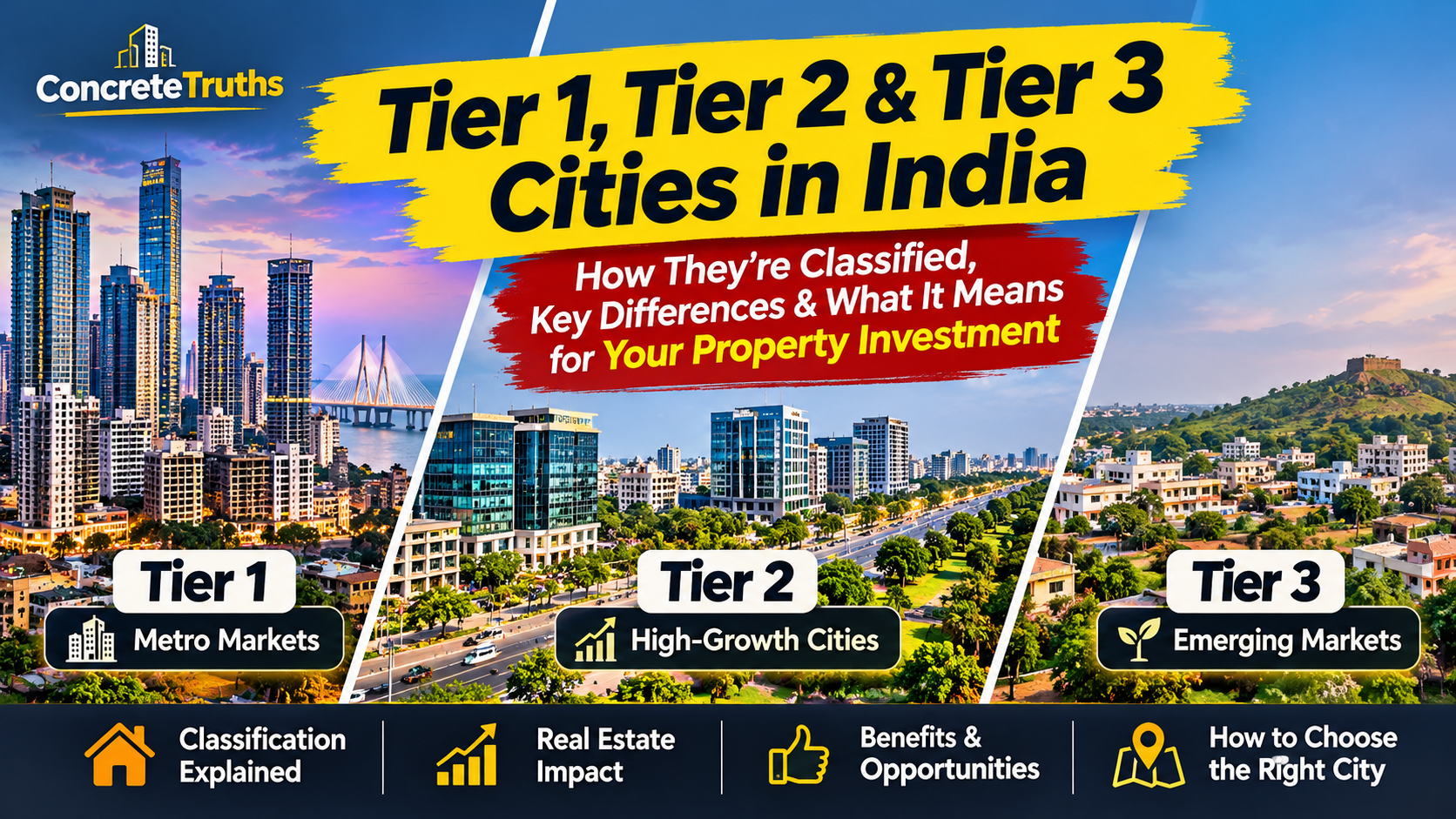
Why Does Everyone Talk About Tier 1, Tier 2 and Tier 3 Cities?
If you follow India’s real estate market, you have probably come across statements like:
- Tier 1 cities have expensive properties.
- Tier 2 cities offer better investment opportunities.
- Tier 3 cities are the next growth destinations.
But have you ever wondered who actually decides whether a city is Tier 1, Tier 2 or Tier 3?
Is it based on population? Infrastructure? Employment opportunities? Economic development? Or property prices?
The interesting answer is that India does not have one universally applicable Tier 1, Tier 2 and Tier 3 classification for every purpose.
Different government departments and institutions use different classification systems depending on their requirements.
Understanding these differences is important, particularly if you are planning to purchase a home or invest in residential property.
Let’s break it down.
1. What Are Tier 1, Tier 2 and Tier 3 Cities?
In common commercial and real estate terminology, cities are broadly grouped according to their economic importance, urban development, infrastructure, employment opportunities and market size.
Tier 1 Cities: Established Metropolitan Markets
These are major economic centres with developed infrastructure, large employment markets, established industries and significant real estate activity.
Examples include:
- Mumbai
- Delhi
- Bengaluru
- Chennai
- Hyderabad
- Kolkata
- Pune
- Ahmedabad
Typical characteristics:
- Higher property prices in established locations.
- Greater concentration of corporate offices and industries.
- Developed public transportation networks.
- Stronger organised rental markets.
- Higher competition among property developers.
Tier 2 Cities: Growing Economic Centres
Tier 2 cities are generally regional economic centres experiencing industrial expansion, infrastructure development and increasing urbanisation.
Examples include:
- Jaipur
- Indore
- Lucknow
- Nagpur
- Nashik
- Surat
- Bhopal
- Kochi
- Vadodara
Typical characteristics:
- Relatively affordable housing in many locations.
- Growing employment opportunities.
- Expansion of educational and healthcare facilities.
- Increasing demand for organised residential projects.
- Infrastructure development and improving connectivity.
Tier 3 Cities: Emerging Urban Markets
These are generally smaller or emerging urban centres with relatively limited economic diversification compared with major metropolitan markets.
Examples vary depending on the classification system and may include smaller cities and developing urban centres.
Typical characteristics:
- Lower land prices in many locations.
- Smaller organised housing markets.
- Developing transportation infrastructure.
- Greater dependence on local economic activity.
- Potential for growth, but sometimes higher liquidity and demand risks.
Important: These are broad commercial descriptions, not a universal government classification.
2. How Does the Indian Government Classify Cities?
One of the biggest misconceptions is that every government department follows the same Tier 1, Tier 2 and Tier 3 classification.
In reality, different institutions use different systems.
A. Reserve Bank of India (RBI): Six-Tier Classification
The RBI classifies banking centres according to population, using Census 2011 figures.
| Tier | Population |
|---|---|
| Tier 1 | 1,00,000 and above |
| Tier 2 | 50,000–99,999 |
| Tier 3 | 20,000–49,999 |
| Tier 4 | 10,000–19,999 |
| Tier 5 | 5,000–9,999 |
| Tier 6 | Below 5,000 |
Under this classification, a centre with a population of just 1 lakh qualifies as Tier 1.
This is very different from the way real estate companies use the term Tier 1.
Source: Reserve Bank of India, tier-wise classification of centres.
B. Central Government: X, Y and Z Classification
For House Rent Allowance (HRA), the Central Government uses another classification system.
| Category | Population threshold |
|---|---|
| X | 50 lakh and above |
| Y | 5 lakh to below 50 lakh |
| Z | Below 5 lakh |
This classification is used for determining applicable HRA categories for Central Government employees.
It is not the same as the commercial Tier 1, Tier 2 and Tier 3 classification.
C. Commercial and Real Estate Classification
Real estate research organisations and businesses may group cities into three broad tiers.
Their classification can consider:
- Population and urbanisation.
- Economic activity and employment.
- Infrastructure and connectivity.
- Household income and purchasing power.
- Housing demand and supply.
- Property market maturity.
Unlike the RBI’s population-based system, this approach considers the overall development and economic importance of a city.
3. Maharashtra Example: Why City Classification Can Be Confusing
Consider Maharashtra.
You might assume that all cities surrounding Mumbai automatically belong to Tier 1 because of their proximity to India’s financial capital.
But that is not necessarily the case.
A National Housing Bank research report published in January 2026 provides a consolidated classification of cities for its housing-market analysis.
| City | NHB Research Classification |
|---|---|
| Mumbai | Tier 1 |
| Pune | Tier 1 |
| Navi Mumbai | Tier 2 |
| Nashik | Tier 2 |
| Nagpur | Tier 2 |
| Kalyan-Dombivli | Tier 2 |
| Vasai-Virar | Tier 2 |
| Thane | Tier 3 |
| Panvel | Tier 3 |
This is the classification used in that particular research report, not a universal government designation.
Interestingly, Panvel and Thane are classified as Tier 3 in this research, while Navi Mumbai is Tier 2.
Does that mean Panvel has poor real estate potential?
Absolutely not.
A city’s investment potential cannot be determined by its tier alone.
The actual infrastructure, employment opportunities, connectivity, housing demand and supply conditions matter much more.
4. What Are the Benefits of City Classification?
City classification helps different stakeholders make informed decisions.
| Stakeholder | Why classification matters |
|---|---|
| Government | Urban infrastructure and development planning |
| Employees | Applicable HRA classification |
| Banks | Banking network expansion |
| Businesses | Selecting locations for expansion |
| Developers | Understanding housing demand |
| Investors | Comparing real estate markets |
| Retail companies | Evaluating purchasing power |
For example, a retail company planning expansion may establish its presence in Mumbai and Pune before entering smaller regional markets.
Similarly, a real estate developer may evaluate land availability, affordability and future demand before entering a Tier 2 or Tier 3 market.
5. Tier 1 vs Tier 2 vs Tier 3: What Does It Mean for Real Estate?
For homebuyers and property investors, the differences can be significant.
| Parameter | Tier 1 | Tier 2 | Tier 3 |
|---|---|---|---|
| Land prices | Generally high | Moderate | Often lower |
| Housing affordability | Relatively low | Moderate | Relatively high |
| Employment market | Established | Growing | More limited |
| Infrastructure | Mature | Developing | Emerging |
| Rental demand | Generally deeper | Developing | Often smaller |
| Developer competition | High | Increasing | Varies |
| Market liquidity | Generally higher | Location dependent | Can be lower |
These are broad market tendencies, not guarantees. Individual neighbourhoods can behave very differently.
Why Are Developers Exploring Tier 2 and Tier 3 Cities?
Several factors are encouraging developers to explore smaller urban markets:
1. Land availability
Developers may find larger parcels of land and more affordable acquisition opportunities outside established metropolitan markets.
2. Industrial expansion
New industrial parks, manufacturing facilities and logistics hubs can create employment and generate demand for housing.
3. Infrastructure development
Highways, airports, railway improvements and public transportation can improve connectivity and make previously less-accessible locations more attractive.
4. Changing housing preferences
As incomes and aspirations change, buyers increasingly seek organised residential developments, better amenities and improved construction quality.
5. Migration and urbanisation
People moving from smaller towns to emerging economic centres can create additional housing demand.
However, infrastructure announcements alone do not guarantee real estate appreciation. Actual execution and economic activity matter.
6. Does Buying Property in a Tier 2 or Tier 3 City Offer Better Returns?
Not necessarily.
A common mistake among property investors is assuming that lower property prices automatically translate into higher future appreciation.
Consider two hypothetical investment opportunities:
| Particulars | City A | City B |
|---|---|---|
| City classification | Tier 1 | Tier 3 |
| Property purchase price | ₹80 lakh | ₹40 lakh |
| Annual rental income | ₹2.4 lakh | ₹1.2 lakh |
| Gross rental yield | 3% | 3% |
| Annual rental yield advantage | None | None |
Despite the difference in purchase price, both properties generate the same gross rental yield.
The cheaper property is not automatically a better investment.
You must also evaluate:
- Actual rental demand.
- Vacancy periods.
- Maintenance expenses.
- Property taxation.
- Resale liquidity.
- Developer credibility.
- Future infrastructure execution.
- New residential supply in the surrounding area.
A property in an emerging market may appreciate significantly, but it may also take longer to find a buyer when you want to sell.
7. Five Things to Check Before Buying Property in an Emerging City
Instead of relying entirely on the city’s tier classification, investigate the actual locality.
1. Employment Generation
Are new industries, IT parks, manufacturing facilities or commercial establishments creating sustainable employment?
Employment creates housing demand.
2. Infrastructure: Announced vs Operational
Do not make investment decisions solely on proposed infrastructure projects.
Check:
- Whether the project has received approvals.
- Whether construction has started.
- Expected completion timelines.
- Actual operational status.
- Connectivity benefits for your specific locality.
3. Actual Population Growth
Is the city attracting permanent residents, working professionals and families?
Population growth driven by employment is generally more sustainable than speculative land purchases.
4. Housing Supply and Unsold Inventory
Are developers launching too many residential projects compared with actual demand?
High unsold inventory can put pressure on prices and rental yields.
5. Legal and Construction Due Diligence
Before purchasing, examine:
- MahaRERA or applicable state RERA registration.
- Land title and ownership documents.
- Approved building plans.
- Commencement Certificate.
- Occupancy Certificate, where applicable.
- Fire safety approvals.
- Structural and construction quality.
- Society formation and maintenance obligations.
A growing city does not make an unsafe or legally defective property a good investment.
8. The Bigger Picture: Should You Focus on City Tier or Micro-Market?
Here is something every homebuyer should understand.
A city’s overall classification tells you very little about the quality of an individual property investment.
For example, two locations in the same city can have completely different investment characteristics.
One locality may have:
- Strong employment connectivity.
- Established schools and hospitals.
- Reliable public transportation.
- Limited new housing supply.
Another locality in the same city may have:
- Poor road connectivity.
- Excessive residential supply.
- Limited employment opportunities.
- Infrastructure projects that are repeatedly delayed.
Both belong to the same city, but their real estate prospects can be dramatically different.
This is why professional property analysis must go beyond city-level classification.
The micro-market matters more than the city-tier label.
Conclusion: Don’t Buy a Property Just Because a City Is Growing
Tier 1, Tier 2 and Tier 3 classifications are useful for understanding broad economic and urban development differences.
However, they should not be treated as a direct indicator of property appreciation, rental income or investment safety.
A Tier 1 city can have overpriced and poorly performing micro-markets. A Tier 3 city can have an attractive investment opportunity if it has genuine employment growth, infrastructure development and sustainable housing demand.
Before investing your hard-earned money, examine the locality, developer, construction quality, legal documents and actual market demand.
At ConcreteTruths, we believe that buying a home should be based on evidence, not marketing promises.
Understand the market. Verify the facts. Make an informed property decision.
About ConcreteTruths
ConcreteTruths is dedicated to helping Indian homebuyers understand the construction industry, evaluate residential projects and make informed property decisions through technical analysis, construction awareness and real estate due diligence.
Disclaimer: This article is for educational purposes and does not constitute financial, investment or legal advice. City classifications vary by institution and purpose. Always verify the relevant official classification before relying on it for a specific decision.
References
- Reserve Bank of India – Tier-wise classification of banking centres: https://www.rbi.org.in/Scripts/NotificationUser.aspx?Id=11570
- Department of Expenditure, Ministry of Finance – HRA classification: https://doe.gov.in/files/circulars_document/hra%281%29_0.pdf
- National Housing Bank – Economic Growth and Housing Prices: Insights for India’s Housing Market (2026): https://www.nhb.org.in/wp-content/uploads/2026/01/Economic-Growth-and-Housing-Prices-Insights-for-Indias-Housing-Market.pdf